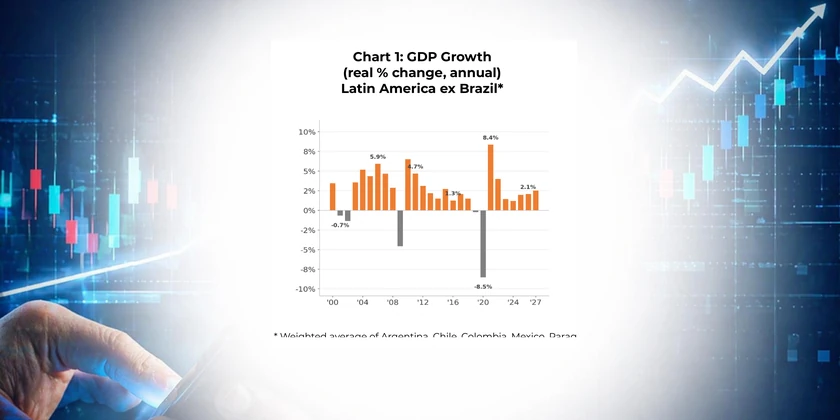
| In this report we present assessments and outlooks for the economies of Argentina, Colombia, Chile, Mexico, Paraguay and Peru. For a financial market that is mostly focused on developed economies and AI themes, some diversification into Latin American emerging markets looks like a potentially interesting alternative. Chile and Peru have already brought inflation close to the center of their targets and cut interest rates; Mexico continues a cautious easing cycle. The exceptions are Colombia, which resumed monetary tightening in mid-2026, and Argentina, which keeps rates high to anchor expectations. The region’s currencies are benefiting from firm commodity prices and a globally weaker dollar. The main risks are political and fiscal. |
Regional Overview
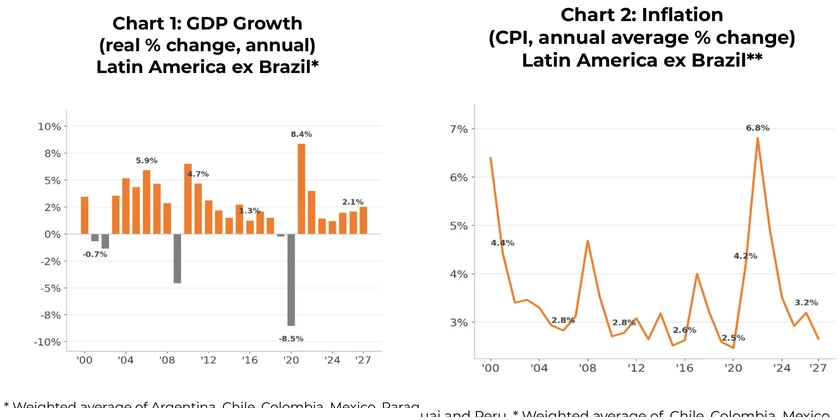
The region is growing again close to its potential — at a modest pace, but a more balanced one than seen in the previous decade — with most countries running single-digit inflation and converging toward their respective targets. Global investor appetite has also been underpinned by a structurally weaker dollar and by a cycle of firmer metals prices favored by the energy transition, alongside energy prices boosted by the conflict in the Gulf.
From a structural standpoint, the most relevant theme for the years ahead is the geopolitical rivalry between the United States and China and its knock-on effects on global supply chains. Nearshoring benefits Mexico above all, but it also opens opportunities for other countries in the region in critical-minerals mining and clean energy. Capturing this window will depend, in each case, on the quality of domestic institutions and each government’s ability to offer regulatory predictability and legal certainty to investors.
Argentina – The Pains of Adjustment
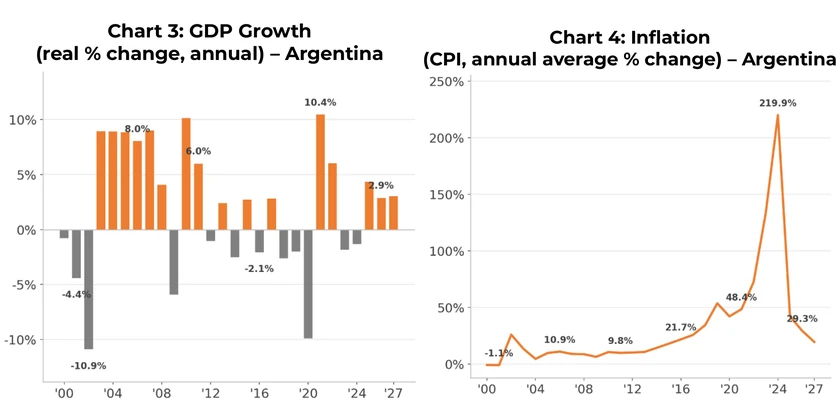
Argentina is going through the most ambitious attempt in decades to break with a historical pattern of fiscal dominance, monetary financing of the deficit, and recurring currency crises. The program bets on a specific sequence: first fiscal balance, then monetary stabilization, and only then a sustained recovery in growth — a reversal of the logic that prevailed for most of the country’s recent economic history.
The most delicate challenge lies in the exchange rate. Decades of currency controls left a stock of repressed imbalances — an overvalued exchange rate, foreign-currency debt, historically low reserves — that need to be normalized without reopening a confidence crisis. Recent external financial support helps smooth this transition, but the decisive test will be the Central Bank’s ability to consistently rebuild reserves as the country migrates toward a freer exchange-rate regime.
On the structural front, Argentina holds potential that few countries in the region possess: unconventional gas and oil reserves in Vaca Muerta comparable to the largest in the world, plus significant lithium deposits in the Andean triangle. Exploiting that potential at scale depends on long-term legal certainty — precisely the kind of commitment that unstable economic-policy regimes have historically struggled to sustain.
The main risk is political and social: the depth of the adjustment demands a level of tolerance that has rarely been sustained for many consecutive years in Argentina’s recent history, and the outcome of the midterm legislative elections serves as a gauge of that support. If the program holds, Argentina has the potential to become one of the most significant risk-reclassification stories of the decade in the region — but the gap between short-term stabilization and durable institutions remains investors’ central point of attention.
Colombia – Inflation Resists, But Fiscal Adjustment Looks More Likely
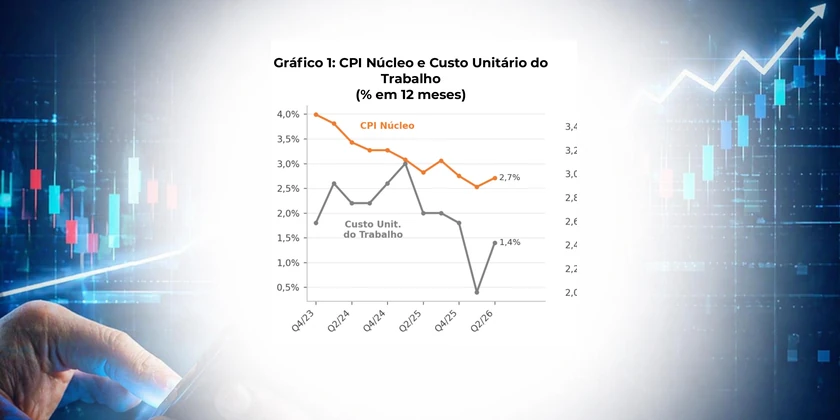
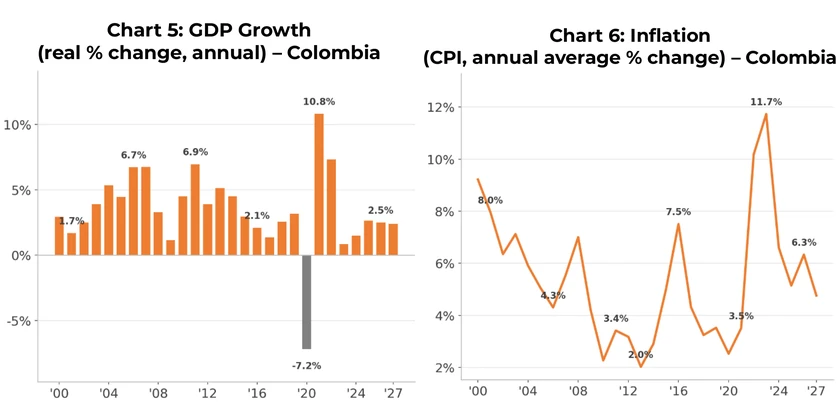
Colombia is today the clearest case, among the region’s large economies, of a disinflation process that has not run its full course. While neighbors such as Chile and Peru have already brought inflation close to the center of their targets, the country continues to deal with more persistent inflation, fed by indexation mechanisms — chiefly the annual minimum-wage adjustment, historically tied to past inflation — that tend to perpetuate the very problem they are meant to correct.
This dynamic has put the central bank (Banrep) in an uncomfortable position: after a cutting cycle, it was forced to tighten monetary policy again, exposing a diagnostic divergence with the government over the urgency of fighting inflation — a tension between fiscal and monetary authorities that the market tends to read as a sign of institutional fragility, and which explains much of the risk premium embedded in Colombian assets.
On the structural front, Colombia faces a challenging energy transition: the decision to restrict new oil and coal exploration contracts, in line with the environmental agenda, reduces the attractiveness of a sector that still accounts for a significant share of exports and fiscal revenue, without alternative sources of revenue having been clearly worked out.
The main short- and medium-term risk is fiscal: the combination of pressured revenue with an ambitious social agenda strains the Colombian fiscal rule, one of the pillars of the credibility built over the previous decade. The 2026 presidential election, won by a more market-friendly candidate, was well received by markets, but governability with a fragmented Congress is the test that will determine whether this shift in signaling translates into effective fiscal results.
Chile – Stability and Credibility
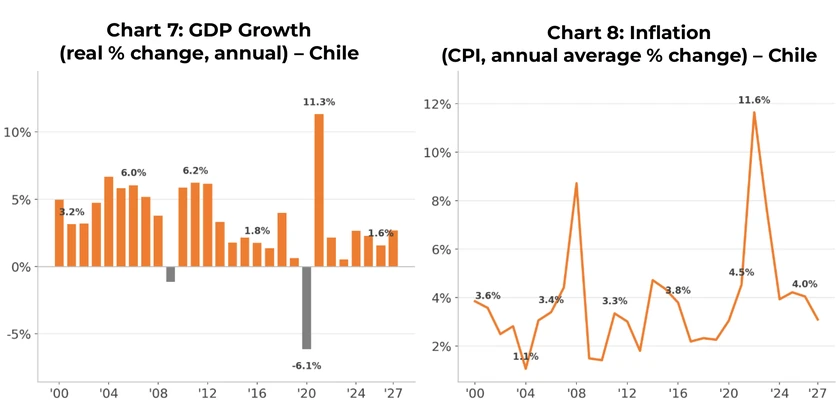
Chile remains the regional benchmark in terms of macroeconomic institutions: an independent, technically respected central bank, a structural fiscal rule that survives alternations between governments of opposing political stripes, and a domestic capital market deep enough to finance a large share of the public sector’s needs in local currency.
Inflation’s convergence to target has been slower than the central bank itself anticipated, largely due to recurring external shocks — from post-pandemic international freight costs to the most recent oil shock — that domestic monetary policy has no direct way to neutralize. The response has been a prolonged pause in the cutting cycle, prioritizing the anchoring of long-term expectations over a faster normalization of interest rates.
Structurally, Chile remains extremely dependent on copper, both for generating foreign exchange and for fiscal revenue via royalties. Added to that is a still largely untapped potential in lithium, whose development runs into a regulatory framework the country is still debating how to balance between attracting private investment and preserving a meaningful state stake.
The risks are concentrated on the political front: Chile’s electoral cycle has produced abrupt swings between left- and right-wing governments, each trying to reverse part of its predecessor’s agenda, which generates recurring regulatory uncertainty for mining and pensions. Externally, a more pronounced slowdown in the Chinese economy — the world’s largest copper buyer — remains the main risk factor outside domestic control.
Mexico – Hostage to Its Ties with the US
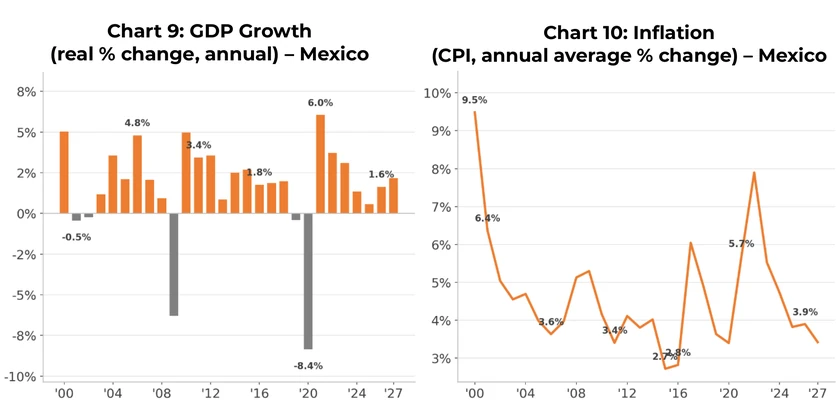
Mexico’s performance remains umbilically tied to the political and trade cycle of the United States, its main trading partner and the destination for more than three-quarters of the country’s exports. Recurring uncertainty over tariffs, quotas, and the review of the trilateral trade agreement has, by itself, been enough to hold back corporate investment decisions — even before any measure is implemented.
The central bank (Banxico) has navigated this environment with a deliberately gradual stance: it has cut rates, but kept monetary policy in still-restrictive territory, preserving ammunition to react should currency volatility intensify. The Mexican peso has proven surprisingly resilient to tariff rhetoric, underpinned by an attractive interest-rate differential and by remittance and direct-investment flows — though both have shown signs of slowing more recently.
The most relevant structural theme is nearshoring: the relocation of supply chains closer to the US market represents the country’s greatest industrialization opportunity in a generation. Capturing that potential, however, runs into domestic bottlenecks — legal uncertainty, energy-policy uncertainty following changes to the roles of Pemex and CFE, and public-security problems along relevant logistics corridors.
The risks are concentrated at the intersection of foreign and domestic policy: an escalation in US tariffs, the review of the trade agreement, and US migration policy — which directly affects remittances — are the main external vectors. Domestically, the continuity of the agenda to strengthen the state’s role in the economy under President Claudia Sheinbaum is being watched closely by investors as a signal of the country’s willingness to compete for productive capital.
Paraguay – Growth with Stability
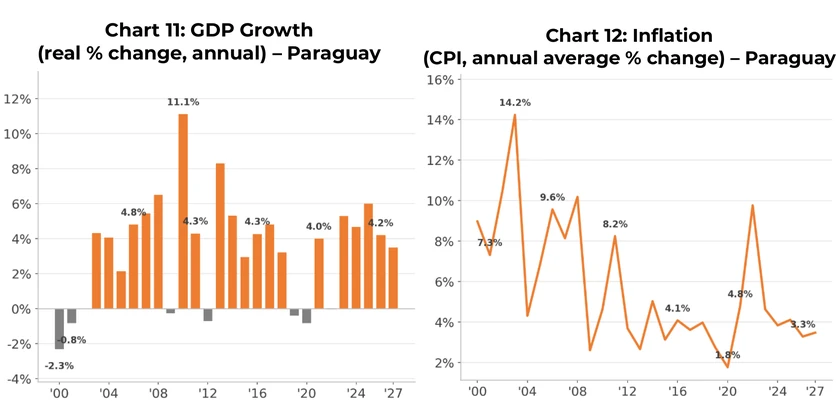
Over the past decade, Paraguay has built one of the most consistent track records of macroeconomic stability in the region — an unusual combination of above-average regional growth with low, well-anchored inflation, reflecting both the maturity of its inflation-targeting regime and a fiscal policy that has historically been more disciplined than that of its larger neighbors.
Paraguay’s monetary policy benefits from a structural advantage that is rarely discussed: the high dollarization of part of the economy limits the room for more aggressive discretionary policies, but it also imposes a natural discipline that helps explain the currency stability observed even during periods of regional turbulence.
The country’s greatest structural asset is energy: the hydroelectric generation capacity of Itaipu and Yacyretá, far exceeding domestic consumption, positions Paraguay as one of the few countries in the world with abundant, cheap clean energy available to attract electricity-intensive industries — from cryptocurrency mining to data centers and, potentially, green hydrogen. Combined with a simple tax regime, this advantage has attracted a growing flow of foreign direct investment.
The risks are mostly external: the economy remains heavily dependent on agribusiness — soybeans and beef, above all — which exposes it to weather swings and international prices beyond its control. Its close trade ties with Brazil and Argentina, its largest Mercosur partners, also mean that crises in those countries tend to spill over into the Paraguayan economy through trade and financial channels.
Peru – Solid Fundamentals, Political Noise
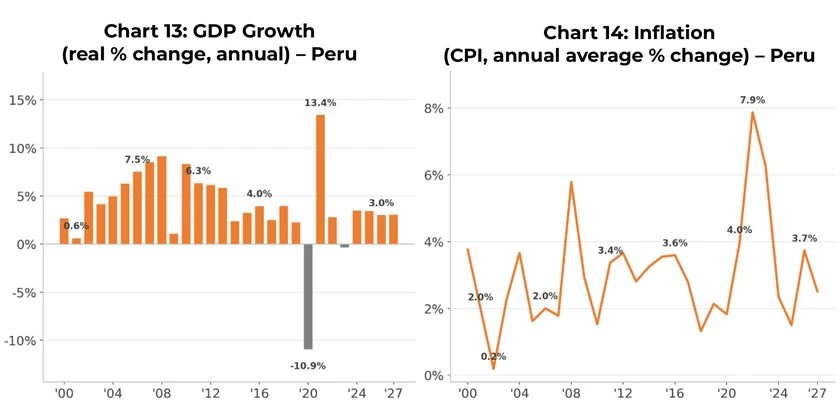
Peru illustrates, perhaps better than any other country in the region, how macroeconomic soundness can be decoupled from political stability. While the country changed presidents with unusual frequency over the past decade — amid impeachments, arrests, and successive institutional crises — its core macroeconomic indicators remained remarkably stable, a testament to the strength of the technical institutions built over the 1990s and 2000s.
The central bank (BCRP) is widely regarded as one of the most technically independent and consistent in Latin America, historically shielded from the political instability that affects other spheres of the Peruvian state. That reputation allows the country to run one of the lowest inflation rates in the emerging world and comparatively low financing costs, even amid successive governability crises.
Structurally, Peru is one of the world’s great copper and gold mining frontiers, with a substantial pipeline of projects yet to be developed. Converting that potential into actual investment, however, repeatedly runs into social conflicts around mining projects — involving local communities, environmental concerns, and royalty disputes.
The main risk remains political and institutional: governance instability, combined with a historically fragmented Congress, keeps uncertainty elevated over the country’s ability to pass the structural reforms needed to fully unlock its growth potential. For investors willing to look past that noise, Peru offers an unusual combination of genuine macro stability with world-class, still-underexploited mining potential.7