US: Resilient Productivity and Contained Labor Costs Support Disinflation

Download File
Reading time: 2 minutes
Tempo de leitura: 2 minutos
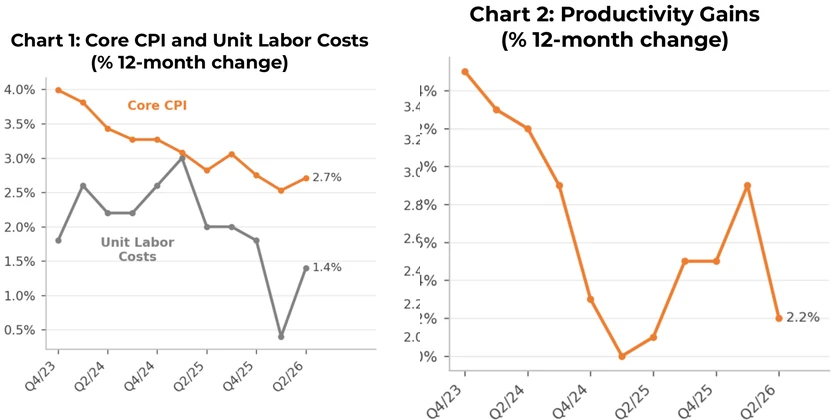
  • Nonfarm business labor productivity (output per hour) rose 1.4% at an annualized rate in the second quarter of 2026 and 2.2% from the same quarter a year earlier (See Chart 2). The result combines a 1.7% increase in output with a mere 0.3% rise in hours worked.
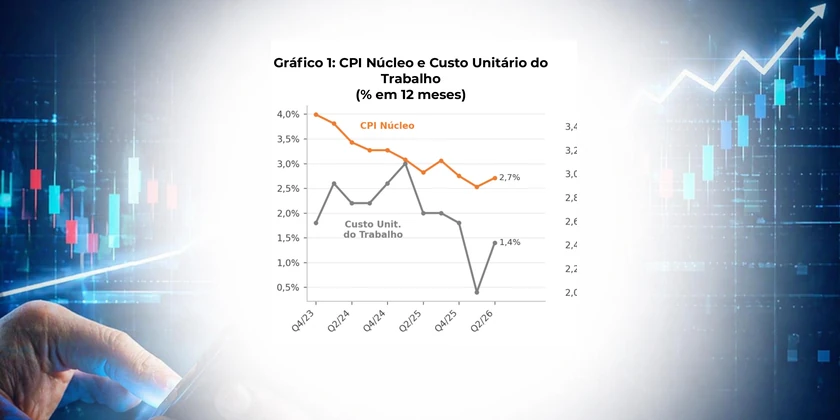
  • Unit labor costs (ULC) rose just 1.3% annualized in the quarter and 1.4% over 12 months — a benign pace that helps explain the ongoing disinflation in core CPI (See Chart 1).
  • Hourly compensation advanced 2.7% annualized, but in real terms fell 3.1% in the quarter, reflecting the period’s still-resilient inflation. With productivity growing in line with hourly pay, cost pressure on prices remains contained.
  • First-quarter data were revised favorably: productivity was raised 0.5 p.p. to 0.8%, and unit labor costs were cut 0.5 p.p. to 1.3% — reinforcing the picture of well-behaved costs.
  • In manufacturing, productivity rose 1.9% in the quarter, with durable goods (+2.7%) ahead of nondurables (+2.0%), a sign that efficiency gains are not confined to services.
  • The structural highlight: productivity is growing 2.1% per year in the current cycle (since Q4 2019), above the previous cycle’s 1.5%. If sustained, this gain lifts the economy’s potential growth and gives the Fed more room to cut rates without rekindling inflation.

Leave a Reply

Your email address will not be published. Required fields are marked *

The hidden game of the market that few dare to expose.

Discover how influence and manipulation shape decisions every day — and learn to see what most overlook.

Newsletter Market Cruncher

Get strategic market insights delivered straight to your inbox.

Stay Informed

Related Articles

A Prosperous Future Will Have to Wait

For the third consecutive election, Brazil is once again debating two competing visions for the country that, at their core, have been familiar since 2018. On one side, the Workers’ Party (PT) continues to see the state as a key driver of economic development. On the other, the Bolsonaro camp advocates a smaller state and a greater role for the private sector. The slogans and circumstances change, but the core of the debate remains largely the same.

Hyperscalers: How Much Is Too Much?

Just 10 of the most relevant companies among the so-called hyperscalers in the United States are set to invest close to a total of USD 1 trillion in 2026, up from a mere USD 100 billion in 2020 (chart 1).

How AI Is Impacting Macroeconomics: The Cases of Taiwan, South Korea, Singapore, Ireland and the Netherlands.

Markets appear increasingly uneasy about the impact of hyperscalers’ outsized demand for resources on long-term interest rates. The challenge seems more significant in the United States than in Asia. It is also important to pay attention to mounting pressures on land and energy. See Pezco Economics’ report on the macroeconomic impact of AI in Taiwan, South Korea, Singapore, Ireland, and the Netherlands.

Newsletter Market Cruncher

Receive strategic market insights directly to your email.

Market Cruncher uses your contact information to send you relevant content.
You can unsubscribe at any time.