| Taiwan and South Korea are today the most visible cases of AI’s macro impact via hardware: semiconductor exports accelerating sharply, GDP and industrial output already reflecting the boom, and record investment from TSMC, Samsung and SK Hynix substantially affecting aggregate gross fixed capital formation. Singapore has established itself as the financial and data hub of Southeast Asia, with Microsoft, AWS and Google investing heavily in cloud infrastructure, though without a domestic hardware “national champion.” Ireland and the Netherlands are the European nodes of the AI chain: the former via data centers, the latter via lithography equipment (ASML). |
Introduction
The artificial intelligence revolution is no longer just a market narrative — it is increasingly and clearly visible in the macroeconomic aggregates of a specific group of countries. The channel through which this impact manifests, however, varies considerably from economy to economy. In Taiwan and South Korea, the channel is hardware: semiconductors, memory chips and servers show up directly in exports and GDP. Singapore has established itself as the main regional data and cloud hub in Southeast Asia. In Ireland and the Netherlands (small open economies), a handful of multinational projects is enough to move aggregate income generation and put pressure on resources.
Taiwan – The Export Boom
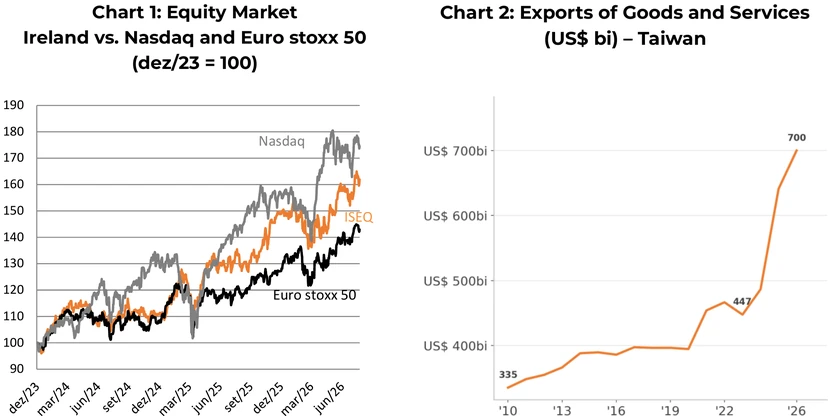
Taiwan is the most direct and measurable case of AI’s macro impact. The channel is essentially hardware: advanced semiconductors, servers and equipment used in the infrastructure for training and running AI models. The country’s official statistics agency has explicitly attributed much of the economy’s recent acceleration to AI demand (chart 3): in the first quarter of 2026, GDP grew 14.5% year-on-year, real exports rose 35% and industrial output advanced 26%, leading the government to project 9.64% growth for 2026 as a whole. This is no longer an expectation about future productivity, but a terms-of-trade and export shock already under way — something one might call an “AI export boom” (chart 4).
TSMC is, by far, the central company in this story. In 2025, the company invested US$41 billion in capex (up from US$28.9 billion in 2024), equivalent to roughly a third of its annual revenue, and has already signaled a capital budget of US$55 billion for 2026, a 40% jump. Most of these resources go toward advanced manufacturing processes, which already account for more than three-quarters of semiconductor revenue, directly reflecting demand for AI chips from customers such as Nvidia and AMD.
In equity markets, the TAIEX index and, above all, TSMC’s own American depositary receipts (ADRs) serve as the main gauge of global appetite for exposure to the AI chain — given the weight of the technology sector in the Taiwanese index. In debt markets, TSMC has funded part of its expansion through low-coupon Taiwan-dollar bond issuances, reflecting a very solid credit profile. The company’s cash generation continues to comfortably exceed its external financing needs, which keeps credit spreads contained despite record capex volumes.
On the currency side, the trade surplus generated by AI chip demand tends to push the Taiwan dollar toward appreciation, and Taiwan’s central bank has a track record of intervening to contain sharp appreciations that would hurt export competitiveness.
South Korea – The Second Memory Powerhouse
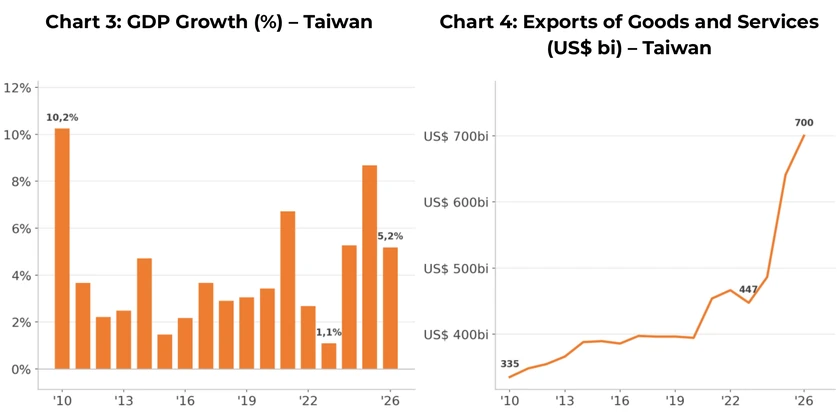
South Korea is extremely sensitive to the AI cycle through its two memory giants, Samsung and SK Hynix, the leading makers of the HBM (high-bandwidth memory) chips used in AI accelerators. Although smaller in magnitude compared to Taiwan, export performance stands out: in the first twenty days of July 2026, South Korean semiconductor exports had surged around 181% year-on-year, driven by AI-related demand and rising memory prices. The effect has already reached public finances: the government announced the creation of a fund to channel part of the windfall revenue generated by the semiconductor boom into public policy and AI investment.
SK Hynix raised its capex by around 50% in 2025, to at least 45 trillion won (US$31 billion), the largest volume in the company’s history, aimed mainly at expanding memory capacity. Over a longer horizon, Samsung and SK Hynix, with government backing, announced in mid-2026 a joint investment plan of roughly US$870 billion over ten years, including a new manufacturing hub worth 800 trillion won (US$518 billion) in the southwest of the country — which gives a sense of the scale of long-term capital commitment to the AI chain.
In equity markets, much of the KOSPI index’s performance is explained by the combined results of Samsung and SK Hynix, whose record profits (Samsung reported operating profit of around US$59.7 billion in the second quarter of 2026 alone, and SK Hynix close to US$42 billion) have sustained the index rally (chart 6). In debt markets, the strength of these results has been compressing the credit spreads of the conglomerates (chaebols) at exactly the moment they most need to issue debt to fund capacity expansion — a mutually reinforcing effect between operating profit and cost of capital. The Korean won has benefited from the trade surplus generated by semiconductor exports, with a currency-support effect similar to that observed in Taiwan.
Singapore – The Financial and Data Hub of Southeast Asia
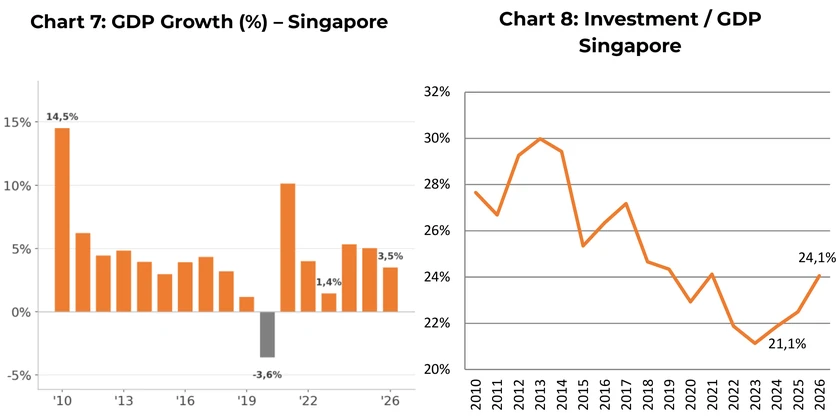
Singapore does not manufacture chips or lead any critical stage of the semiconductor supply chain, but it has established itself as the main regional data and cloud hub in Southeast Asia. The macroeconomic impact channel is almost entirely digital infrastructure and financial services, not hardware. GDP accelerated to around 5.0% in 2025 (up from 1.45% in 2023, chart 7), with inflation under control at 0.9% — one of Asia’s best combined growth-and-prices results, partly attributed to the data center and cloud boom and to the country’s position as a regional hub for banking and technology. Growth in the information and communication sector in the national accounts has consistently outpaced the economy’s average.
After a four-year moratorium on new data centers (due to energy and land constraints), the government has released, since December 2025, at least 200 MW of new capacity, conditional on clean energy, with rights granted to Equinix, Microsoft, GDS and an AirTrunk/ByteDance consortium. Microsoft announced in April 2026 US$5.5 billion in cloud and AI investment in the country through 2029; AWS had already committed US$9 billion in 2024; and Google, present since 2011, has invested around US$5 billion cumulatively. Government and private sector combined are expected to invest around US$27 billion in AI infrastructure through 2030. The declining trend in investment as a share of GDP has been reversed (chart 8).
The effect on the equity market is modest: Singapore has no domestic “TSMC” or “ASML” whose shares directly capture the AI boom. The Straits Times Index (STI) is dominated by three large banks (DBS, OCBC and UOB) that account for more than half the index and have driven the rally to record levels (above 5,000 points in 2026), much more through wealth management — boosted by regional capital inflows — than through direct exposure to chips or data centers. In debt markets, the AAA sovereign rating keeps local spreads among the lowest in Asia, with data center expansion funded mostly by big tech foreign direct investment rather than leveraged domestic corporate debt.
Worth noting is the pressure on electricity costs and commercial real estate prices near data center hubs — the same competition for energy and land observed in Ireland and the Netherlands.
Ireland – The Physical Laboratory of AI
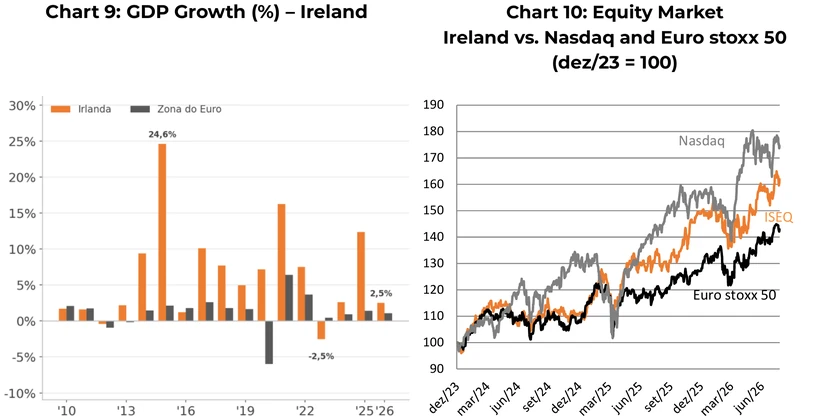
Ireland may be the most interesting and least obvious case of AI’s macro impact, because the channel is not hardware but physical infrastructure: data centers. Ireland’s central bank has already stated that data center and AI-related investment significantly influences the country’s gross fixed capital formation. Data centers consumed around 22% to 23% of all Irish electricity in 2025, and the grid operator projects that share could reach a third by the early next decade — a rare case in which AI shows up simultaneously in aggregate investment, equipment imports and the country’s power mix. GDP is growing at a faster pace than the euro area average (chart 9).
Microsoft, Amazon and Google are the main players. In aggregate, the sector has already invested more than €18 billion (about US$21 billion) in digital infrastructure, with another €5.8 billion planned — a volume that, according to industry associations, is “stuck” awaiting available grid capacity.
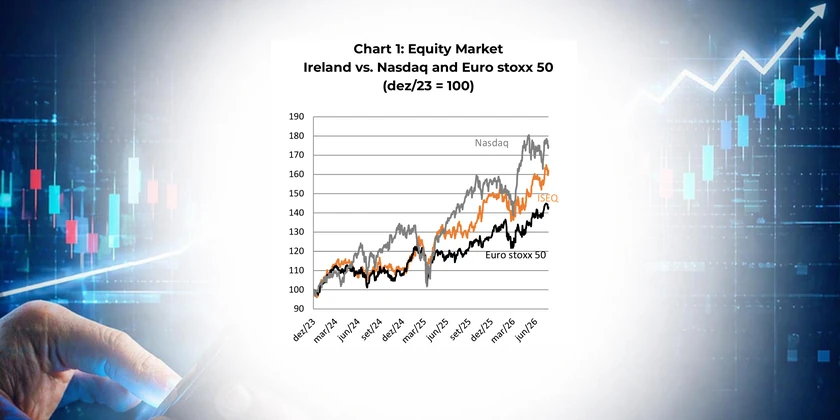
Ireland does not have a domestically listed technology sector with weight comparable to the American giants, so the effect on the local equity market (the ISEQ index, on the Euronext Dublin exchange) is more indirect than in Taiwan or Korea. Even so, performance looks favorable compared to peers (chart 10).
An important impact is fiscal: the technology multinationals based in the country, which benefit from a favorable tax regime, account for more than half of Irish corporate income tax revenue. This keeps Irish sovereign debt spreads historically low, but it also exposes public finances to a concentration risk that rating agencies and the IMF itself have flagged as a vulnerability.
The most visible effect on domestic prices is the cost of energy: data centers’ electricity consumption has been contributing to tighter tariffs and to grid capacity availability itself — a bottleneck that is already diverting new investment projects to other regions of Europe.
The Netherlands – The World’s Bottleneck Runs Through Veldhoven
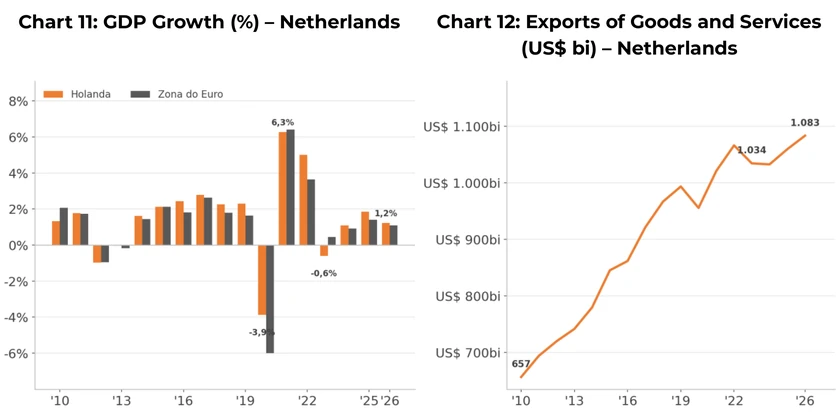
The Netherlands makes this list for a very specific reason: ASML, headquartered in Veldhoven, is the world’s only maker of extreme ultraviolet (EUV) lithography machines, technology indispensable for producing the most advanced semiconductors used in AI. Since this involves a single company within an already developed and dynamic economy, the impact on GDP growth (chart 11) and on exports (chart 12), when viewed in aggregate terms, ends up being relatively small.
The company does not manufacture AI chips. It manufactures the machines without which no one else can manufacture them, which makes it a structural bottleneck — and, for that very reason, one of the most strategic assets — in the entire global AI chain. A second, less well-known channel is data centers: they already accounted for 4.6% of total Dutch electricity consumption in 2024, up from 3.3% in 2021, with a growth pace that is starting to run into grid congestion around Amsterdam.
ASML’s 2025 numbers illustrate the intensity of demand. The company raised its 2026 revenue guidance twice over the course of the year, reaching a range of €45 billion by July. Besi, the Dutch maker of advanced packaging equipment (hybrid bonding), saw its orders more than double in the second quarter of 2026, also driven by AI demand.
ASML is the most valuable company listed in Europe, and the AEX index of the Amsterdam exchange tracks its moves closely: the stock was up more than 115% year-to-date through July 2026. In debt markets, the effect shows up less through corporate credit spreads (ASML funds its expansion mostly through its own cash generation, having even announced a €12 billion share buyback program through 2028) and more through a broader risk/return reclassification that benefits Dutch issuers linked to the semiconductor chain.
The trade surplus generated by ASML’s exports of extremely high value-added capital goods contributes to the country’s current account balance. The most concrete point of attention, as in Ireland and Singapore, is competition for grid capacity and land, which is already starting to divert new data center projects to other European regions.