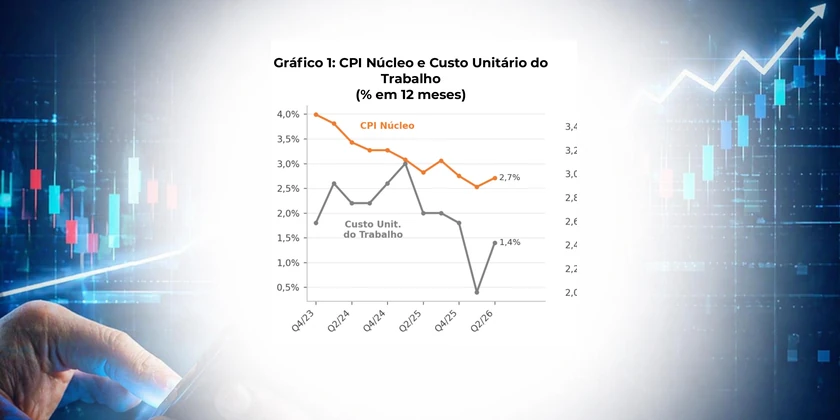
- The productivity and labor cost indicators show a dynamic that is favorable for the Fed, in that it is characterized by labor cost pressures that are virtually nonexistent from the standpoint of firms (Chart 1).
- But it is far more favorable for companies. Employees appear to be capturing very little of the efficiency gains linked to Artificial Intelligence. Labor’s share of income fell to 52.9%, the lowest level in the series that began in 1947. The environment should remain favorable for investment, profits and equity market gains. And unfavorable for income distribution.
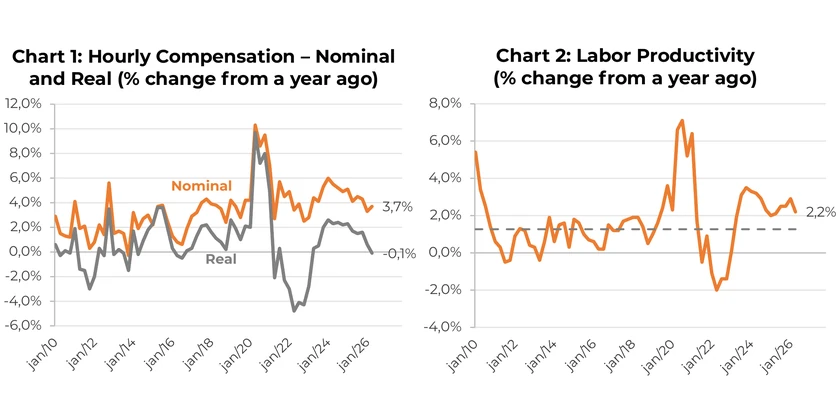
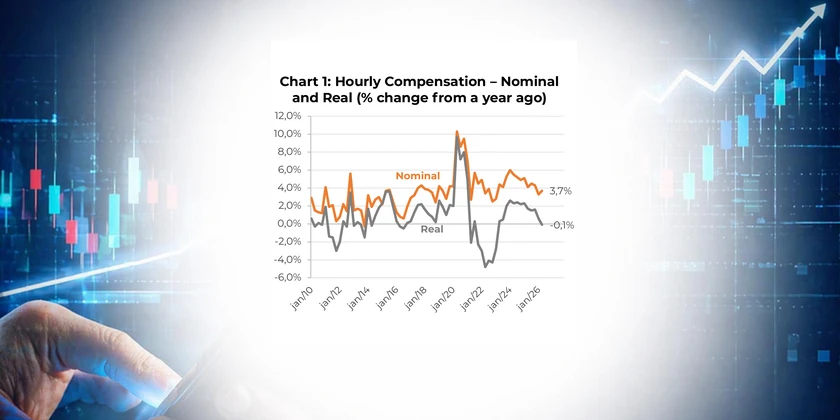
- Labor productivity (output per hour worked) in the nonfarm business sector rose 1.4% in the second quarter (annualized rate) and 2.2% from the same quarter of 2025 (Chart 2). Unit labor costs (the indicator that actually matters for inflation) advanced just 1.3% in the quarter and 1.4% over 12 months. Hourly compensation, in nominal terms, grew 3.7% over 12 months, but real compensation fell 0.1%, the first decline since the first quarter of 2023.
- It is worth noting that productivity growth remains well above the pattern of the past decade: 2.2% over 12 months against an average of 1.3% between 2010 and 2019. Since the fourth quarter of 2019, the cycle has accumulated 2.1% a year.
- For the members of the FOMC (the Federal Reserve’s monetary policy committee), the combination is comfortable. It is important to remember that it is the unit cost, and not the wage, that enters the inflation equation: with productivity accelerating, nominal wages growing close to 4% cease to be a source of cost pressure.