- The 2026 oil price shock affected Brazil and the United States differently. In U.S. dollar terms, Brent crude rose much more than in BRL terms. This sharper increase, combined with a more market-oriented economic structure, resulted in a stronger initial impact on consumer prices in the United States.
- Although the immediate pass-through to core inflation measures was broadly similar in both countries, inflation expectations and interest rates increased much more in Brazil.
- A persistently expansionary fiscal stance, a tighter output gap, and, above all, a monetary policy framework characterized by lower credibility help explain why 10-year inflation expectations have risen more sharply and remained more persistent in Brazil than in the United States. As a result, the real interest rate differential between the two countries is likely to remain elevated.
Introduction
The supply shock triggered by the escalation of the Middle East conflict in 2026 pushed international oil prices up abruptly, hitting Brazil and the United States simultaneously. But the way each economy absorbed the shock — and, above all, the way long-term inflation expectations reacted in each country — was quite different. In this piece we argue that this difference stems, decisively, from the credibility of monetary policy in each country.
Supply shocks tend to produce a sharper and far more persistent rise in inflation expectations in Brazil than in the United States, precisely because economic agents have less confidence in the ability and willingness of Brazilian authorities to bring inflation back to target after the shock.
The Oil Shock Compared: Dollar vs. Real
The Middle East conflict has returned to the center of global market attention by raising uncertainty about the security of energy supply. Although the region’s oil production remains relatively resilient, the risk of disruptions to strategic export routes — especially the Strait of Hormuz — has significantly increased the risk premium embedded in oil prices. Even when there are no actual production losses, the mere possibility of restrictions on the transport of oil and oil products tends to raise market volatility and reinforce speculative moves.
For the global economy, higher oil prices are a major source of inflationary pressure, especially through the costs of fuel, transportation and industrial inputs. Should tensions drag on or cause more severe supply disruptions, central banks could face a more challenging environment, with persistently high inflation and less room to cut interest rates. Conversely, an eventual de-escalation of the conflict and the normalization of export flows would tend to reduce the geopolitical premium currently built into oil prices, easing part of these pressures on global inflation.
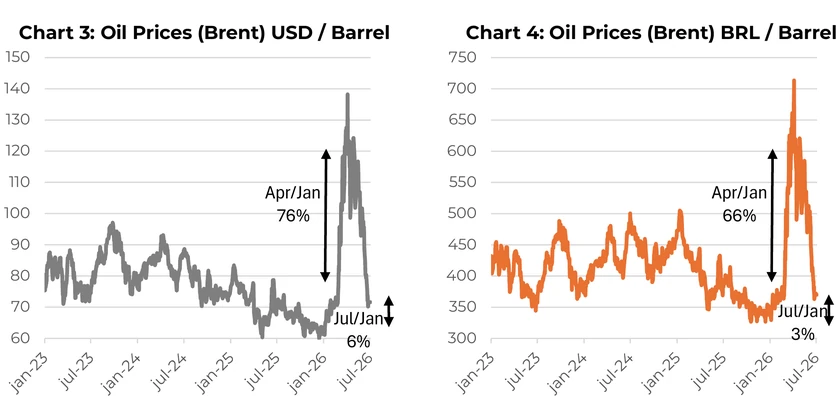
In dollars, the price of a Brent barrel went from US$ 67.30 in January 2026 (average) to US$ 118.36 in April, a 76% increase (Chart 3). In reais, however, the same movement produced a more modest variation of 66%, owing to the appreciation of the real over the period (Chart 4). This means the exchange rate worked as a partial shock absorber for Brazilian consumers, while Americans felt a stronger effect. Currency appreciation also helped on the way down. In the first days of July, the commodity’s price measured in US dollars was still 6.5% above the average observed in the first month of the year, while the same differential measured in reais stood at 3.6%.
Even though the difference is not very large, it is worth highlighting the mitigating effect of the exchange rate in the Brazilian case because, contrary to what intuition might suggest, we will see below that the consequences in terms of expected inflation and interest rates turn out to be more severe here.
Immediate Impact on Inflation – Headline and Core
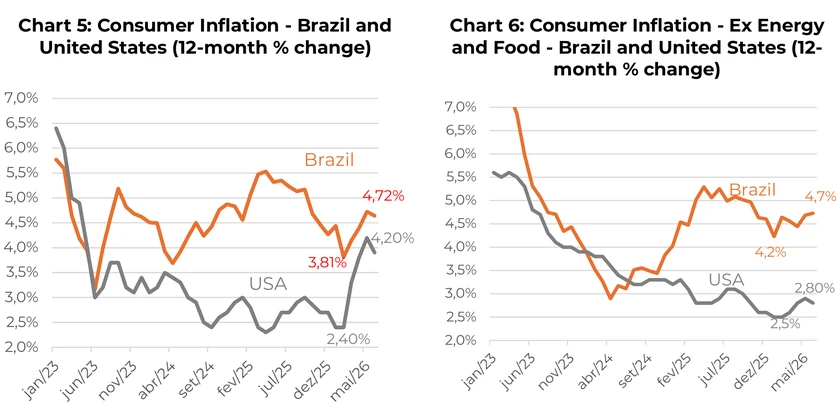
The charts below illustrate the impact of the oil price shock on the main consumer inflation indicators in Brazil and the United States. The sharper increase in Brent crude prices in U.S. dollar terms, combined with the more market-oriented structure of the U.S. economy, resulted in a stronger initial impact on American consumers. Twelve-month headline inflation increased by roughly 1.8 percentage points in the United States between February and May, compared with about 0.8 percentage points in Brazil (Chart 5).
The impact on underlying inflation was broadly similar in both countries, at around 0.5 percentage points (Chart 6). This core measure, which excludes food and energy prices, is particularly useful because it better captures second-round effects – that is, the pass-through of the initial shock to other prices across the economy that are not directly affected by changes in oil prices.
Although the initial impact on consumers was more pronounced in the United States, there are reasons to believe that Brazil may face a more challenging outlook. As discussed earlier, the overall effect – including over the longer term – should, in principle, be smaller in Brazil, since the appreciation of the exchange rate cushioned the increase in domestic energy and fuel prices when measured in Brazilian reais. Inflation expectations, however, suggest otherwise.
In the United States, changes in fuel and energy prices are passed through to consumers almost immediately, reflecting a largely market-based pricing system in which external shocks are quickly incorporated into consumer prices. In Brazil, by contrast, governments have historically adopted a more interventionist approach, relying on subsidies, tax relief, and administrative measures to limit, at least temporarily, the pass-through of higher fuel prices to consumers. Such policies may make sense as a short-term strategy by preventing an abrupt increase in the cost of living. They also create an important long-term side effect: they signal to economic agents that the adjustment will eventually have to occur, either through delayed price increases or through the fiscal cost associated with maintaining those subsidies.
This factor, together with the comparatively lower credibility of Brazil’s monetary policy framework, suggests that the inflationary cost of the shock is likely to prove more persistent in Brazil.
Fiscal Impulse and Pressure on Productive Capacity
Two other factors also conspire to fuel the expectation of a stronger impact of the oil shock on Brazilian inflation: fiscal policy and the balance between demand and aggregate supply.
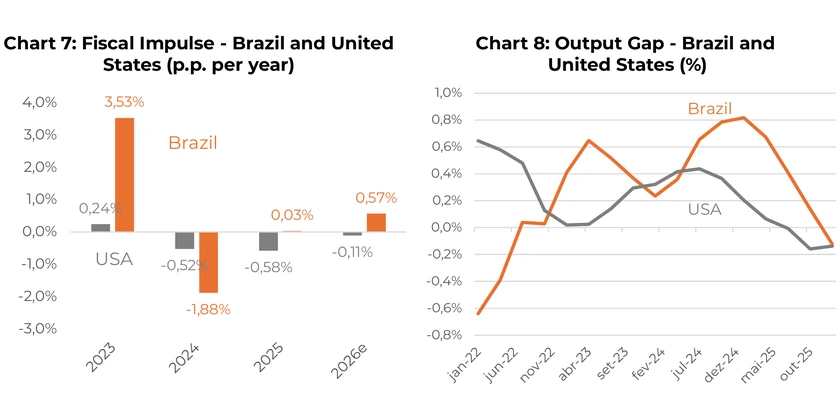
Chart 7 below shows a simple measure of fiscal impulse: the year-on-year change in the primary balance. It reveals the enormous expansion of the gap between spending and revenues that took place in Brazil in 2023, only marginally reversed in 2024. In the 2026 election year, a significant spending increase is already locked in. In the United States, by contrast, the bias has been contractionary over the same period, even though austerity has proven far less intense than expected at the start of President Donald Trump’s term (see: Trump at 500 Days: Much Ado About (Almost) Nothing).
The second issue is the pressure on production factors. As a gap indicator, we use here the difference between actual and potential GDP (estimated by applying the same statistical filter to the Brazilian and American series). Chart 8 shows that, throughout virtually the entire 2023-2025 period, Brazil’s gap was positive (the economy operating above its potential), reaching nearly +0.8% at the end of 2024. Meanwhile, the American gap hovered near zero or in negative territory most of the time.
The combination of an expansionary fiscal impulse with a historically tighter gap leaves the Brazilian economy more vulnerable to a supply shock: there is less spare capacity to absorb the shock without pass-through to prices, and fiscal policy, instead of helping contain demand, pushes the other way. This backdrop helps explain why, in Brazil, a shock like the oil one tends to contaminate longer-term inflation expectations more.
The Result: Higher Expectations in the Brazilian Case
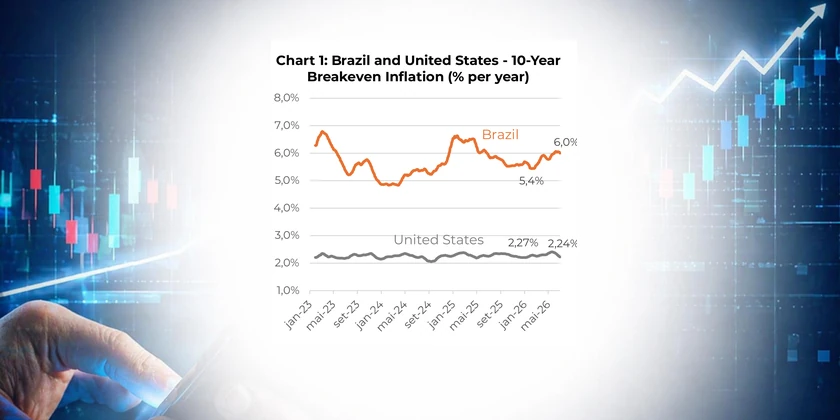
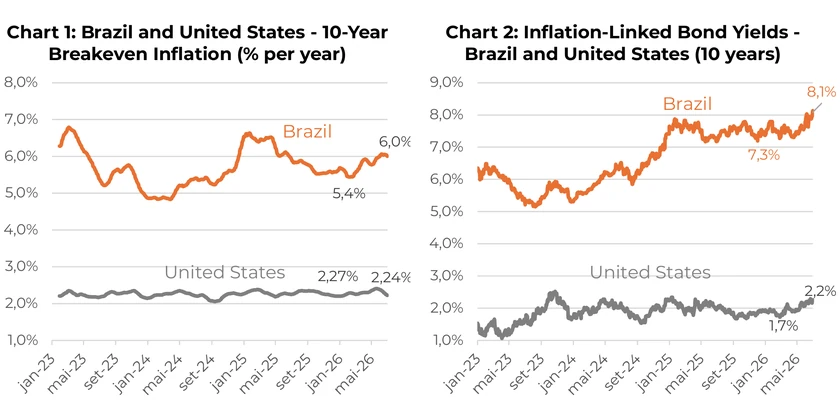
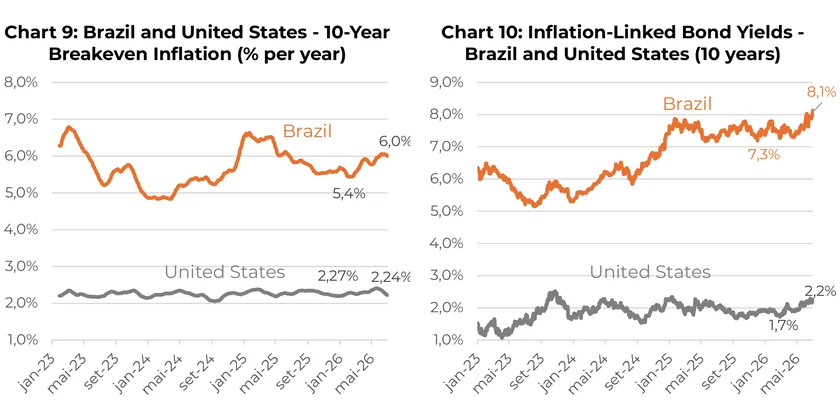
It is in 10-year breakeven inflation — extracted from the difference between nominal and inflation-linked bonds — that the asymmetry becomes most evident. In the United States, the inflation embedded in fixed income market prices remained around 2.3% between January and July. This means that, in the view of market participants, the impact of higher oil prices would be only temporary.
In Brazil, the same measure went from 5.4% in January (average) to 6% in June (Chart 9). This difference in behavior is not accidental. The factors already discussed — the interventionist response, the fiscal impulse and the output gap — explain part of the story. The common backdrop, however, is the credibility of monetary policy. Economic agents do not seem to believe that, in Brazil’s case, the pass-through of the energy shock to the rest of the economy’s prices will be met with fiscal and monetary policies aimed at preventing further pass-through along the production chains. In other words, there is no belief that the federal government and the Central Bank have the will and/or the ability to bring inflation back to target after a shock. It is this belief — and not the shock itself — that explains why expected inflation rises more, and takes much longer to recede, in Brazil.
If economic agents believe that a given inflation target will be pursued with great determination by the monetary authority, the rational tendency is to expect future inflation to converge to that target. And if all agents form that same expectation, decisions on prices, wages and contracts come to be made in line with that belief. This phenomenon is known as the anchoring of expectations. Anchored expectations make the monetary authority’s job much easier: a supply shock tends to be treated as temporary, without contaminating forward-looking price decisions, and monetary policy does not need to react as aggressively to contain its second-round effects.
This explains why interest rates here are so high and why they tend to rise further when a supply shock hits. This is not the result of cyclical factors, but of a set of policies biased toward the very short term — policies that erode credibility and cost the country dearly.