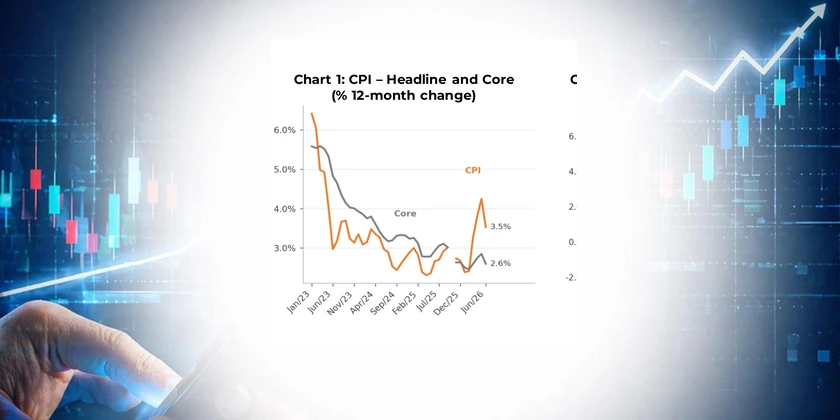
We have consistently argued that the disinflation trend had already come to an end late last year (see “US CPI: Now You See Me”). For some time, relatively benign core inflation readings were largely driven by the owners’ equivalent rent component, whose deceleration reflected methodological factors (lower interest rates) rather than genuine market dynamics.
Our latest assessment is that the recent oil price shock has not been strong enough to generate a sustained upward inflation trend. We expect year-over-year core inflation to remain around 2.5% for the CPI and close to 3.0% for the PCE deflator for some time.
Monetary policy decisions will depend much more on the Federal Reserve’s willingness to bring inflation back to target than on concerns about renewed inflationary pressures. In our view, the most likely outcome is that the Fed will keep its policy rate unchanged, at least through the end of the year.
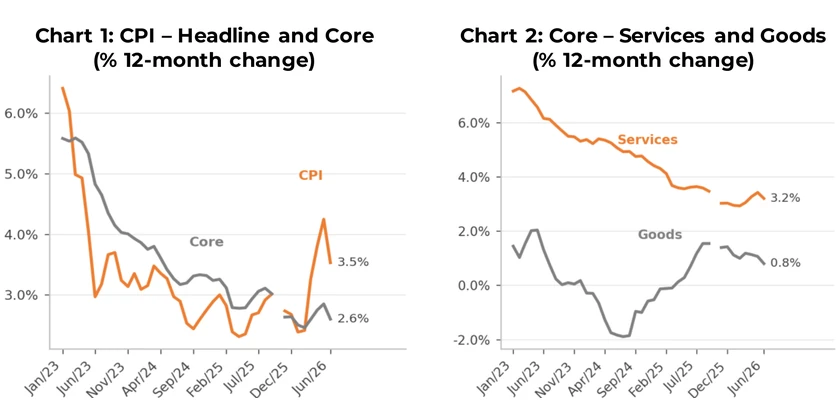
The Consumer Price Index (CPI) declined 0.4% in June (seasonally adjusted), following a 0.5% increase in May. Core CPI (excluding food and energy) was unchanged during the month (0.0% vs. 0.2% in May). On a 12-month basis, headline inflation slowed from 4.2% in May to 3.5% in June, while core inflation eased from 2.9% to 2.6% (see Chart 1).
The breakdown of core inflation is particularly noteworthy. Core services inflation (excluding energy) slowed to 3.2% year-over-year, while core goods inflation (excluding food and energy) continued to moderate, reaching 0.8% (see Chart 2). This composition reinforces the ongoing disinflation narrative, even though inflation remains above the Fed’s target.
The shelter index rose just 0.1% in June, its smallest monthly increase since January 2021. However, the 12-month increase remained elevated at 3.4%, suggesting that it will not be easy for core inflation to resume a sustained downward trend over the coming months.