Summary and Conclusions
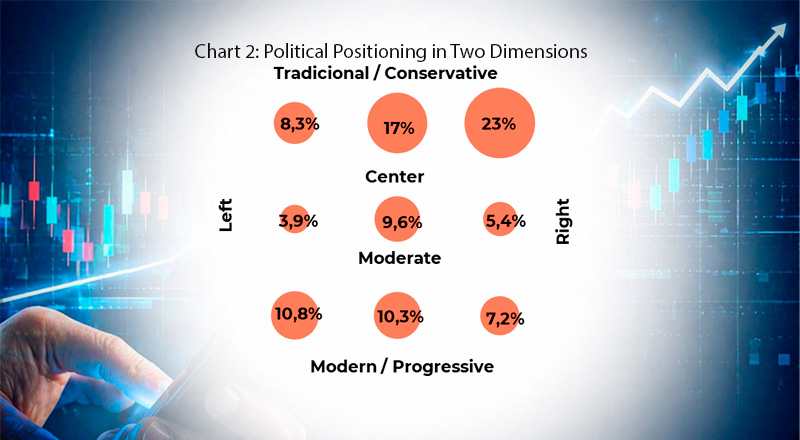
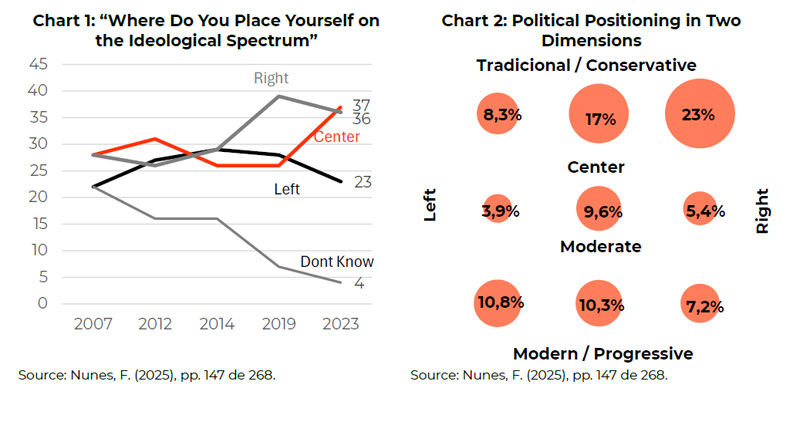
| Brazilians are predominantly conservative. Most people tend to uphold traditional values related to religion and family, as well as stereotypical views about gender roles, while showing limited acceptance of minorities (difference is tolerated, but often perceived as uncomfortable in the public sphere). We know that a society’s behaviors and opinions are influenced by how secure people feel about their own survival: the greater the sense of fear, the more individuals tend to rely on discipline imposed by religion and traditional values[1]. Charts 1 and 2 show how Brazilian society has increasingly identified itself as more right-leaning and more conservative over the past decades. |
- Brazil will hold elections in October 2026 for president, governors of the 27 federative units, all seats in both state and federal legislatures, and two-thirds of the Senate.
- Both the ability to plan a campaign and to assign a well-grounded probability to expected outcomes, with consequent implications for the macroeconomic scenario, fundamentally depend on a solid understanding of Brazil’s socioeconomic context, as well as how voters position themselves (their main fears and aspirations).
- In the first report, we discussed polarization and pessimism. In the second, we examined the anxieties of Brazilian voters. We now turn to the population’s value system.
Conservatives vs. Progressives and Right vs. Left
The analysis developed here is based on data from the Pew Research Center and on the findings published in “Brazil in the Mirror: A Guide to Understanding Brazil and Brazilians” by researcher Felipe Nunes. The former aims to position Brazil relative to other countries, while the latter provides more granular insights into how Brazilians perceive their own society.
We will use the following definitions: Progressives are those who advocate for faster social change and for institutions to adapt more rapidly to societal transformations, whereas Conservatives prefer slower processes. In other words, the latter tend to be more resistant to new ideas, especially when they differ from customs and practices consolidated over decades. Progressives tend to view institutions as subject to continuous improvement rather than as fixed structures. Conservatives, in turn, are seen as those who value traditions and prevailing social norms, supporting only gradual change and exercising caution toward novelty.
In terms of positioning along the ideological spectrum, we adopt the concepts presented in Nunes, F. (2025), p. 142 of 268: the left is associated with the defense of equality as a means to achieve societal development, while the right is more closely linked to the idea that natural inequalities exist among individuals and that these differences are important for social development.
Brazil vis-à-vis a Sample of Countries
The Pew Research Center is an independent research institute based in the United States, recognized for producing reliable data and studies on public opinion, social conditions, the economy, technology, and religion. The organization does not advocate political positions and defines itself as factual and non-opinionated.
A Pew Research Center analysis released on March 5, 2026 examines how adults in a sample of countries assess morality across different topics. The analysis is based on nationally representative surveys conducted between January 8 and April 26, 2025. We consider a sample of 20 countries: South Africa, Germany, Argentina, Australia, Brazil, Canada, South Korea, Spain, the United States, France, Greece, Hungary, Italy, Japan, Mexico, the Netherlands, Poland, Kenya, the United Kingdom, and Sweden.
The figures presented in Chart 3 on the next page show the percentage of individuals who consider each of the listed topics to be morally acceptable or not a moral issue at all. We compare Brazil’s results with the median of the country sample. The lower the acceptance rate, the more conservative society is deemed to be. Chart 4 aggregates the various topics for each country into an indicator expressed in standard deviations relative to the mean.
It is easy to observe that the group analyzed tends to be relatively accepting of topics such as the use of contraceptives, divorce, homosexuality, alcohol consumption, and even abortion. By contrast, gambling, pornography, marijuana use, and extramarital affairs are perceived as less tolerable. As this is a median measure, there is naturally significant variation across countries. In the United States and Canada, for example, gambling is viewed as highly acceptable by more than two-thirds of the population.
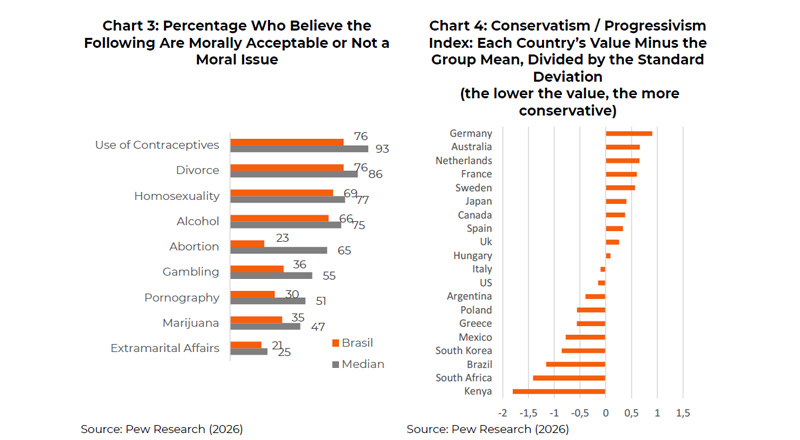
When we compare Brazil’s data with the medians, a clear pattern of relative conservatism emerges across all the topics surveyed. Looking at each issue individually, attitudes toward abortion stand out: only 23% consider it morally acceptable, well below the sample average of 65%, and only slightly higher than the figure recorded in Kenya (17%).
Chart 4 shows that, on average across topics, Brazil is less conservative only than Kenya and South Africa (within the selected sample). The data support the view that European countries tend to be more progressive, consistent with the notion that greater security regarding survival leads to societies that are less attached to religion and traditional values. It is worth noting, however, the position of the United States in the middle of the ranking, with an aggregate indicator close to the average despite its high level of development. When comparing Americans with Brazilians, we find that the former are more tolerant on all topics except homosexuality and extramarital affairs. is another issue that has gained prominence.
How Brazilians See Themselves
See the table/chart on the next page, which provides a map of values, attitudes, and perceptions based on 19 questions covering topics such as religion, gender, homosexuality, welfare policies, and though-on-crime approach. The data appear to reinforce the view that Brazilians are predominantly conservative. Most people tend to uphold traditional values related to religion and family, as well as stereotypical views about gender roles, while showing limited acceptance of minorities (difference is tolerated, but often perceived as uncomfortable in the public sphere).
God and family rank as the top priorities for Brazilians. Religiosity is a defining trait and appears to be gaining relevance over time. Between 1991 and 2022, the share of people identifying as Catholic fell from 83% to 57%, while those identifying as Evangelical rose from 9% to 27%. Evangelical churches often adopt more secular (non-religious) practices, such as music, social gatherings, cooperative activities, and philanthropy. Their adherents also seem more likely to attend services (around 80%) than Catholics attend church (roughly 65%), which may make them more susceptible to influence in their political attitudes and opinions. The growth of Protestant churches, together with population aging, may partly explain the rise in conservatism observed in recent decades.
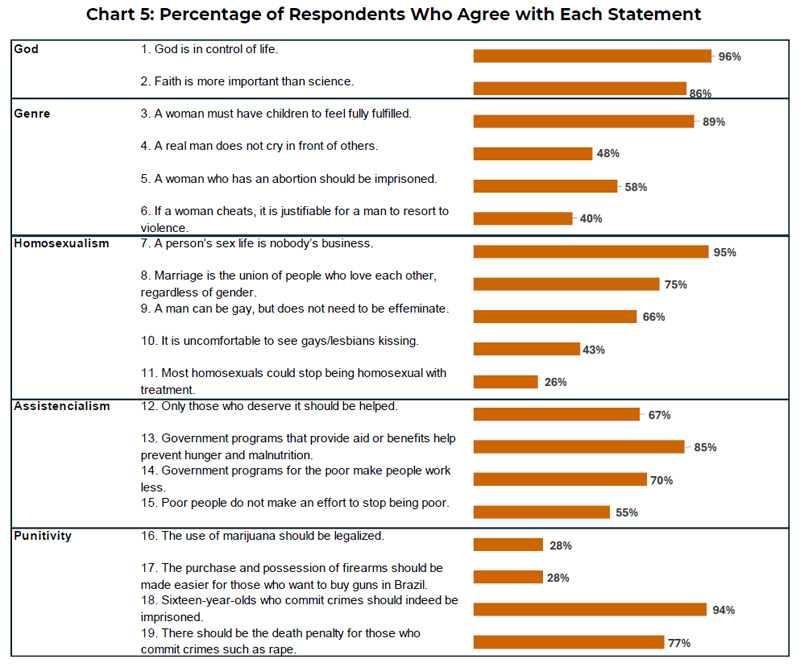
Attitudes toward gender also reveal a traditionalist bias. Women are expected to have children, men are not supposed to cry, and abortion is not considered acceptable (as already seen in the cross-country comparison). It is striking that around one-third of the population believes that violence against women can be justified in cases of infidelity (42% among men and 30% among women themselves). While Brazilians report accepting homosexuality (69% in the Pew survey), this tolerance does not fully extend to the public sphere: “effeminate” behavior or same-sex displays of affection are viewed negatively by a significant portion of respondents.
Beyond insecurity, which is linked to conservatism, religious moralism also helps explain tough-on-crime approach. Fear tends to foster simple and seemingly urgent solutions: repression and harsher penalties are often seen as effective remedies for what is perceived as the misuse of free will.
The religious dimension may also help explain attitudes toward meritocracy. Most respondents believe that income transfer programs should be restricted to those who deserve it. Otherwise, many people may reduce their efforts to improve their own lives.
Conclusion
We have sought, across three reports, to present a framework mapping the perceptions, values, aspirations, and fears of the Brazilian population, with the aim of providing insights into the potential outcome of the 2026 elections as a function of the issues that may rise to prominence in the public agenda during the most critical phase of voter decision-making.
Opposition to the current government is likely to benefit from the growing tendency toward conservatism observed in recent decades. The broader environment also appears to favor a change in power, given the climate of pessimism that seems to prevail across several segments of society. The negative agenda dominating the news, particularly involving key institutions and actors (judges, legislators, and business leaders), has fueled fear and increased the salience of interconnected issues such as organized crime, corruption, and violence. All of this contributes to an environment marked by dissatisfaction, fear, and a desire for change.
The outlook for the incumbent candidacy appears more challenging, although several alternative paths remain. From a macroeconomic scenario-building perspective, it is important to consider the risk that, the more adverse the environment becomes, the greater the likelihood that the current government adopts more extremist policy positions.
The incumbent presidential candidacy is still perceived by the population as strong in its ability to reduce inequality (through income transfers and taxation of higher-income groups) and to generate employment. These issues may not currently be seen as the most pressing, but if there is a growing perception that recent gains in employment and income are at risk, the hierarchy of priorities could shift. Discussions around the minimum wage and working hours are likely to support the progressive camp.
The institutional environment is turbulent. Corruption and favoritism now appear to have replaced the risk of authoritarianism as the primary concern that dominated the 2022 elections. The prevailing mood is one of opposition to “everything that is currently in place.” However, political campaigns are precisely designed to reshape such perceptions. New developments, scandals, and previously unknown connections have changed the course of many elections.
Contrary to what opinion polls and most analyses suggest, the opposition appears to hold an advantage. The probabilities associated with different scenarios will depend on which issues gain the most traction over the course of the campaign. These may be driven by marketing strategies, opinion leaders, or even imposed by unfolding events. We hope that this analysis has helped establish clearer links between each theme and potential electoral outcomes.
References
Inglehart, R. e Norris, P. Sacred and Secular: Religion and Politics Worldwide. Cambridge University Press. 2004.
Nunes, F. O Brasil no Espelho: Um Guia para Entender o Brasil e os Brasileiros. GloboLivros. Rio de janeiro. 2025.
Pew Research Center. https://www.pewresearch.org/religion/2026/03/05/in-25-country-survey-americans-especially-likely-to-view-fellow-citizens-as-morally-bad/?_gl=1*1exsryk*_up*MQ..*_gs*MQ..&gclid=Cj0KCQjwve7NBhC-ARIsALZy9HVDnFmQdKxX3hjKNr3nsNPqp1eLD3Mk2UK9o447ELHUqdFAROlG3vIaAi2REALw_wcB&gbraid=0AAAAA-ddO9F4Yw3JopWbUrcIND02WnbwR. 2026
[1] Inglehart, R. and Norris. P.