Brazil – Fiscal and Credit Activism Working Against the Central Bank and in Favor of Excessive Indebtedness

Download File
Reading time: 2 minutes
Tempo de leitura: 2 minutos
  • What happens when fiscal stimulus and directed credit expansion are excessive? The answer: the monetary authority is forced to maintain excessively high interest rates to contain inflation, which worsens the financial situation of both households and firms.
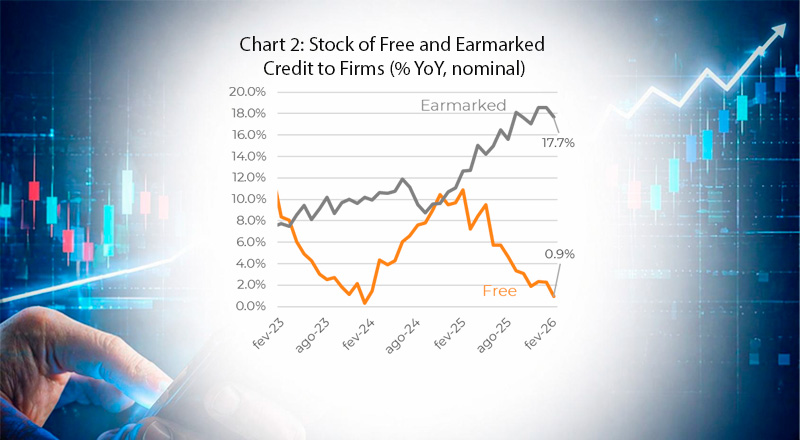
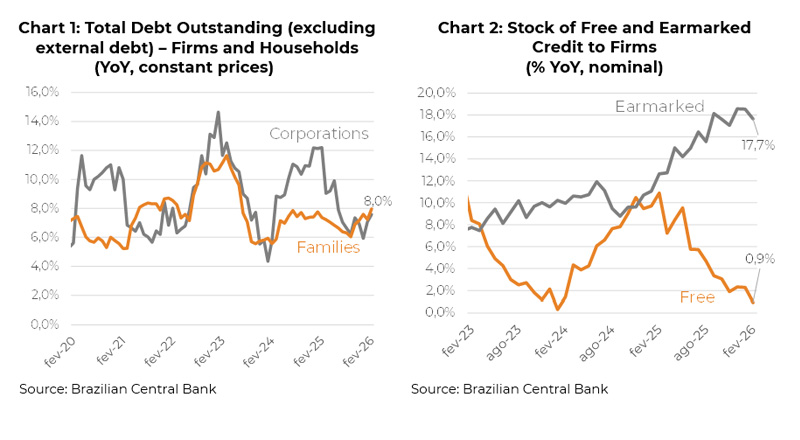
  • This is what today’s credit data show. Household and corporate indebtedness is rising at a pace of 7% to 8% per year above inflation (Chart 1). Fiscal stimulus generates excess demand for goods and services, but also for credit. Moreover, the expansion of directed lending more than offsets the transmission of monetary policy through free-market credit within the financial system (Chart 2).
  • The problem is that this model is unsustainable. Financial tightening for both households and firms is already becoming a problem. The burden is reflected in both the stock and the cost of debt.
  • Total credit operations of the National Financial System reached BRL 7.1 trillion in February, up 9.5% year-over-year, with +7.4% for corporates and +11.2% for households. The non-performing loan (NPL) ratio of the overall credit portfolio rose 0.2 percentage points in the month to 4.3%, with increases of 0.2 p.p. for both corporate and household segments, reaching 2.6% and 5.2%, respectively.
  • Household indebtedness stood at 49.7% in January, stable in the month and up 1.1 p.p. over twelve months. The debt service ratio increased 0.1 p.p. in the month and 1.6 p.p. over twelve months, reaching 29.3% of disposable income.
Leave a Reply

Your email address will not be published. Required fields are marked *

The hidden game of the market that few dare to expose.

Discover how influence and manipulation shape decisions every day — and learn to see what most overlook.

Newsletter Market Cruncher

Get strategic market insights delivered straight to your inbox.

Stay Informed

Related Articles

Foreign Currency Reserves: Use With Care

We argue here that, far more than serving as a liquidity backstop for periods of dysfunction in the foreign-exchange market, reserves have the primary function of signaling that the country is able to generate foreign currency to honor its external commitments.

When Deleveraging Leads to Recession

The reversal of the downward trend in unemployment, the rise in inflation expected for next year (constraining any credible monetary-policy easing), low confidence in the private sector and further tightening of credit-granting standards suggest that a relevant part of the adjustment will come through a combination of higher default and contracting consumption.

2027 Will Be a Very Difficult Year

The slowdown in domestic demand is already under way and tends to deepen in 2027. Cyclical sectors, credit, interest rates, the fiscal adjustment and the labor market all point to much weaker domestic demand next year.

Newsletter Market Cruncher

Receive strategic market insights directly to your email.

Market Cruncher uses your contact information to send you relevant content.
You can unsubscribe at any time.