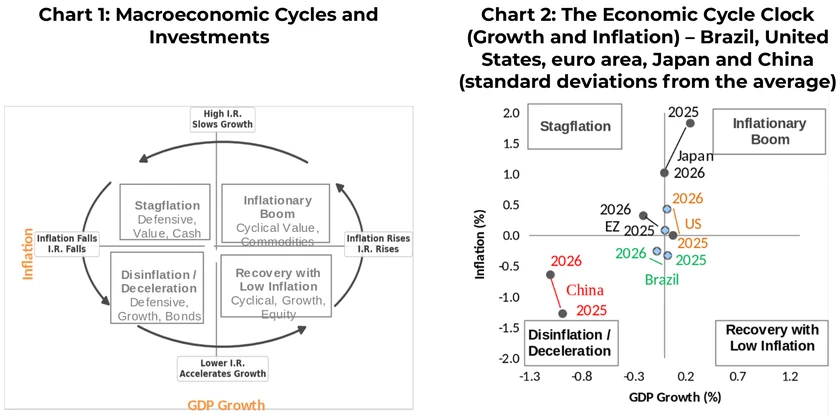
| Economic growth has been slowing in Brazil. After reaching 3.4% in 2024, real GDP growth should converge to around 1.5% next year. This loss of momentum is necessary to bring inflation (which reached 5% in 2025) down to the 3% target. Without a credible spending-restraint program, it will not be possible to move the country back into the quadrants of economic growth with genuinely low inflation. Both the United States and the euro area have kept growth and inflation rates not far from their multi-decade averages. The oil shock has already reversed the downward trend in price indicators, but expectations have changed little. The ECB is expected to raise its policy rate, while the Fed should keep the Fed Funds rate on hold, watching unemployment more closely than the inflation target. For structural reasons, China should continue to struggle to exit the weakening quadrant. Further monetary and fiscal stimulus is expected for an economy whose growth has become even more dependent on exports. The Japanese economy has entered a cycle of moderate expansion in recent years, after decades of stagnation. Deflation has ceased to exist, and the relevant quadrant is now closer to a modest inflationary boom. The trend for interest rates is upward. |
Macroeconomic Cycles
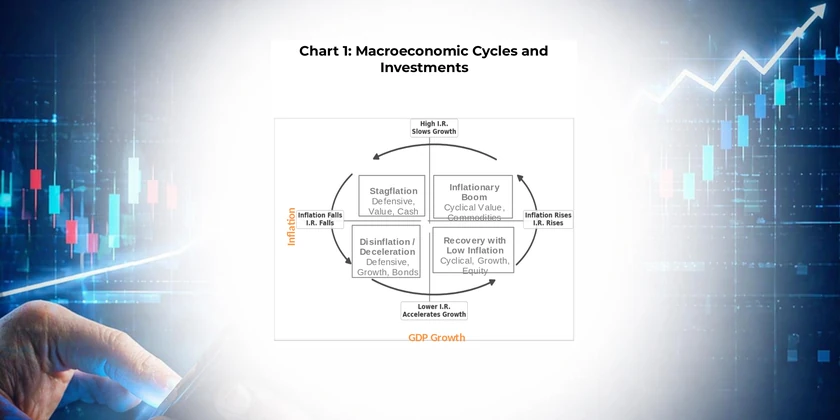
Macroeconomic cycles represent the natural oscillations of economic activity over time. Each phase of the macroeconomic cycle is characterized by a distinct combination of growth, inflation, and economic policy. Chart 1 illustrates the dynamics. Chart 2 seeks to position Brazil, the United States, the euro area, Japan, and China relative to their point in the cycle, based on the deviations of the growth and inflation indicators from their averages, measured in standard deviations.
The Economic Cycle Clock
In the expansion phase (Boom), rising demand typically boosts production, employment, credit, and corporate profits, reducing slack in the economy. As this expansion matures, inflationary pressures begin to emerge, leading central banks to raise interest rates to curb excess demand. Monetary tightening slows consumption and investment, ushering in a deceleration phase that, if sufficiently intense, can evolve into a situation of stagflation, marked by falling activity and rising unemployment with still-elevated inflation.
The weakening of the economy eventually reduces inflation (Deceleration / Disinflation) and allows central banks to ease monetary policy, making financial conditions more favorable. Credit begins to grow again and a new recovery phase begins, which gradually turns into a new expansion, restarting the cycle (Recovery with Low Inflation).
Implications for Investment
Understanding the economy’s position within the macroeconomic cycle is fundamental to investment decision-making. There is no single, permanent optimal portfolio: the relative attractiveness of asset classes changes as the economy moves through the phases of growth and inflation. The logic of the “cycle clock” suggests rotation. In an inflationary expansion, in which activity accelerates and inflation rises, real and cyclical assets tied to prices (such as commodities, shares in cycle-sensitive sectors, and value strategies) tend to outperform. When high interest rates finally slow the economy and inflation still persists (stagflation), the pendulum swings toward more defensive stances, with a greater weight on cash and protection. As inflation recedes and central banks begin to cut interest rates, fixed income comes to the fore. And in the recovery with low inflation, credit begins to flow again and equities (especially growth and cyclical stocks) tend to lead.
Methodology
We seek to situate our sample of economies (Brazil, the United States, the euro area, China, and Japan) based on annual growth and inflation data over the period from 2005 to 2027. For the years 2026 and 2027 we use the consensus of projections for each variable as our basis. The horizontal and vertical axes mark precisely the average of the GDP growth and inflation readings, respectively.
Current Conditions
Unlike other moments in recent history, the current picture is marked by the absence of a synchronized global cycle. The combination of an intense process of technological innovation (led by advances in artificial intelligence) and supply shocks (such as swings in oil prices) has produced distinct trajectories among the major economies.
Brazil – The Land of Fixed Income
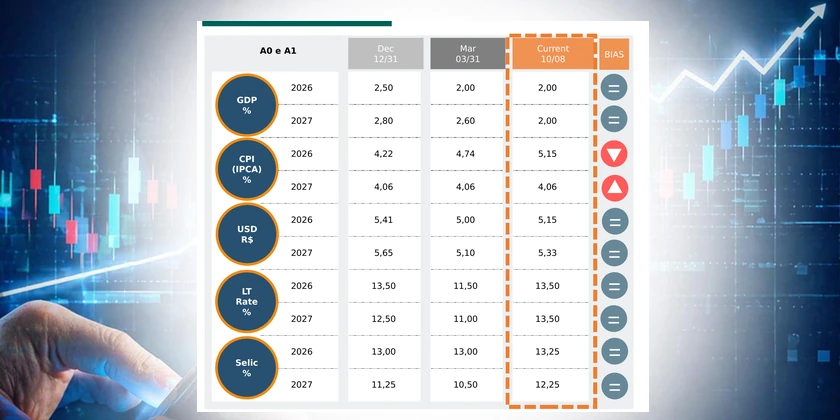
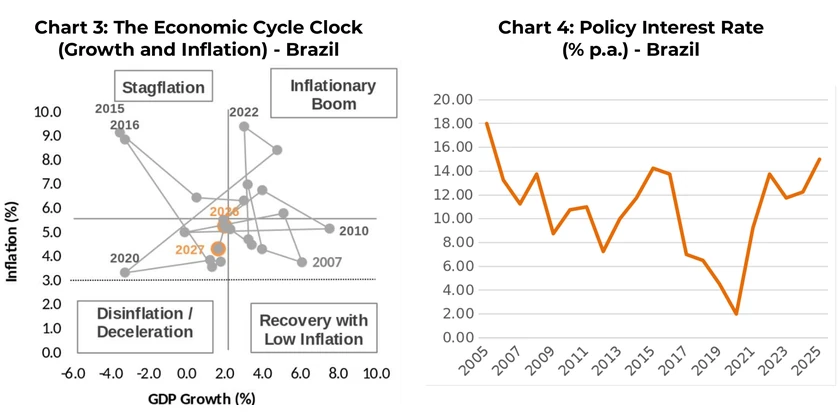
Economic growth has been slowing in Brazil. After reaching 3.4% in 2024, real GDP growth should converge to around 1.5% next year. This loss of momentum is necessary to bring inflation (which reached 5% in 2025) down to the 3% target. Chart 3 classifies IPCA readings that fall below 5.5% (the 20-year average) as moderate. But the difficulties for monetary policy to meet its objectives are clear in an environment of strong fiscal expansion (we address this topic in “Public Spending Rises 30% Above Inflation in 6 Years”).
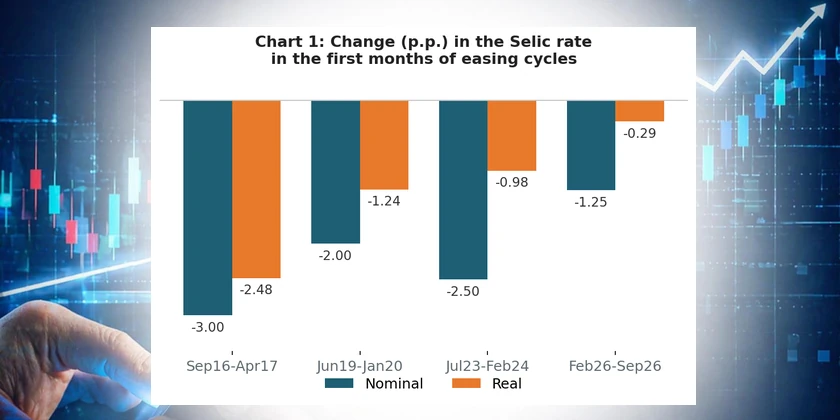
The conflicts in the Middle East have affected the Brazilian economy in an ambiguous way. As a net oil exporter, the real has strengthened, which represents a downward vector for prices. But the track record of missing the IPCA targets and the lack of commitment to fiscal adjustment pushes inflation expectations upward (see Oil Shock and Inflation: Brazil vs. United States). The net effect is upward for interest rates (Chart 4).
Without a credible spending-restraint program, it will not be possible to move the country back into the quadrants of economic growth with genuinely low inflation.
The general elections of October 2026 add a significant layer of uncertainty to the Brazilian economic scenario and are likely to condition market behavior throughout the year. In a polarized presidential race, the main focus falls less on the names and more on perceptions of commitment to fiscal adjustment. This will be the decisive variable for anchoring inflation expectations and for the speed at which Brazil can advance from the current phase of high interest rates toward a sustainable equilibrium. The challenge lies in the fact that electoral periods have historically kept volatility elevated until the economic-policy framework of the next government becomes clearer.
United States and the Euro Area – Fine-Tuning and Preferences
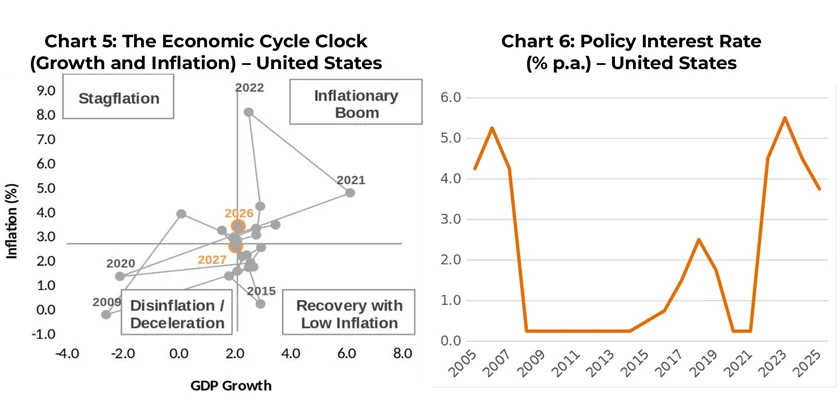
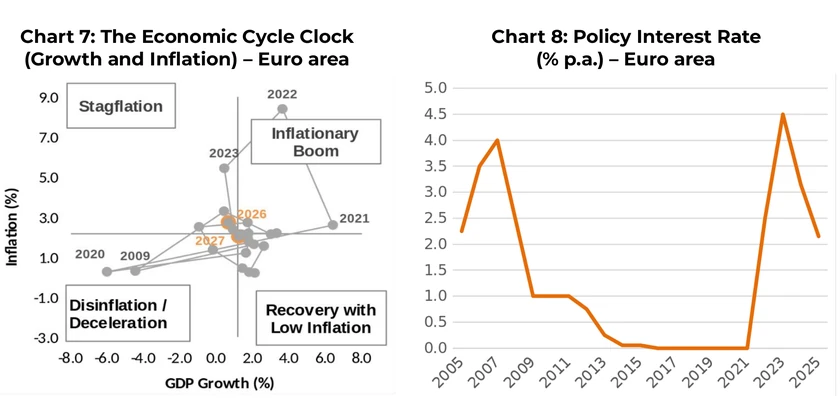
Both the United States and the euro area have kept growth and inflation rates not far from their multi-decade averages. The oil shock has already reversed the downward trend in price indicators, but expectations have changed little.
The US economy should continue growing between 2% and 2.5% in 2026 and 2027, a pace consistent with a decline in inflation, but not convergence to the 2% target (the consensus of projections is 3.5% for 2026 and 2.5% in 2027). The Federal Reserve has talked tough but done little to meet its price-related objective. The commitment to keeping unemployment low has prevailed. For precisely this reason, it is quite likely that the monetary authority will not raise the Fed Funds rate in 2026.
The European Central Bank, for its part, did not hesitate to act in the face of the supply shock, in line with its historically stricter stance on inflation. Growth accelerates from 2026 (0.7%) to 2027 (1.2%), placing the region in the recovery-with-low-inflation quadrant (with inflation easing from 2.7% to 2%, respectively).
China – Disinflation / Deceleration
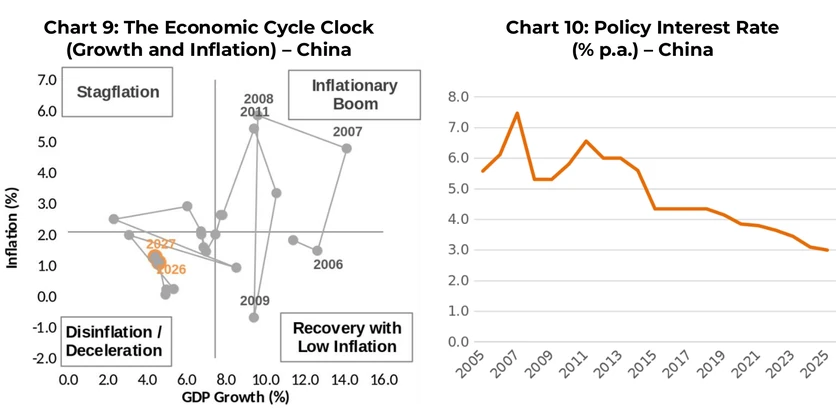
For structural reasons, China should continue to struggle to exit the weakening quadrant. Potential growth tends to keep declining as the population ages and productivity gains associated with the migration of workers from the countryside to the cities are exhausted. Excessive investment in infrastructure sectors is also already producing more modest marginal productivity gains. The trend is for further interest rate cuts and more expansionary government interventions.
The projection for GDP expansion in 2026 is around 4.5% to 4.8% (the weakest pace in decades). This result has become increasingly dependent on the external sector: the country recorded a record trade surplus (around US$1.19 trillion in 2025), with exports accounting for approximately one-third of growth. Stripping out this impulse, underlying domestic demand would advance to something between 2% and 3%. The most evident symptom of the imbalance is deflation: the CPI runs close to 0.8%, well below the 2% target, after about ten quarters of consumer inflation near zero or negative, while producer prices have accumulated more than three years in negative territory.
At the heart of the problem lies the fragility of domestic demand, anchored by the real-estate crisis. Home sales have fallen about 65% from their 2020 peak, launches have retreated more than 70%, and prices in major cities have declined by 15% to 30%, in a process marked by the default of large developers. The weakening of real-estate wealth, combined with a limited social safety net and high youth unemployment (16.9% in March 2026), leads households to prioritize saving over consumption, which feeds back into deflation. In response, Beijing has combined monetary easing (low interest rates, with the one-year LPR around 3%) and fiscal stimulus — bond issuance by local governments and infrastructure spending — while relying on industry and exports, a strategy that, however, aggravates external trade tensions.
Japan – Inflationary “Boom”
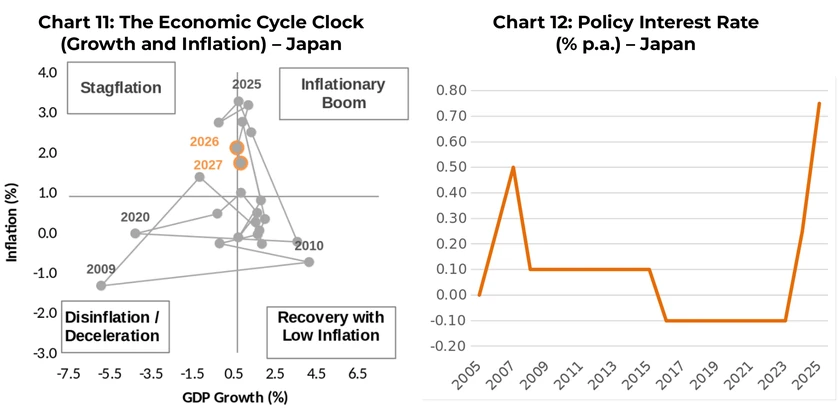
The Japanese economy has entered a cycle of moderate expansion in recent years, after decades of stagnation. Deflation has ceased to exist, and the relevant quadrant is now closer to a modest inflationary boom. The trend for interest rates is upward.
Consumer inflation has consolidated around 2.1%, above the target, sustained by an unprecedented structural element: rising wages. Growth remains weak, though above the average of recent decades: GDP should advance only about 0.5% to 0.6% in 2026, with the economy supported in part by a depreciated yen that reinforces export competitiveness, albeit at the cost of reducing households’ purchasing power.
This regime change unlocked the normalization of monetary policy. The Bank of Japan gradually raised interest rates to 0.75% (the highest level since 1995), although it opted for a pause in April 2026 in the face of energy shocks associated with the Middle East conflict (even with part of the committee advocating an immediate hike to 1.0%). The turn in interest rates is already reflected in the debt market: the 10-year bond yield reached 2.50%, the highest since 1997. This move, however, runs up against a significant constraint: public debt at around 226% of GDP, the highest among developed economies, which makes rising financing costs a source of fiscal pressure and imposes caution on the pace of normalization. The central question for the authorities is whether the virtuous cycle of wages and prices is robust enough to justify continued tightening.
On the cycle clock, Japan distinguishes itself from the other economies by moving out of the deflationary quadrant toward reflation: positive and rising inflation, rising interest rates, but still-modest growth.