The week begins with the Brent crude oil futures contract trading at US$97.80 per barrel. If it closes near this level, it will mark the first daily close below US$100 since April 24, providing some relief to market interest rates.
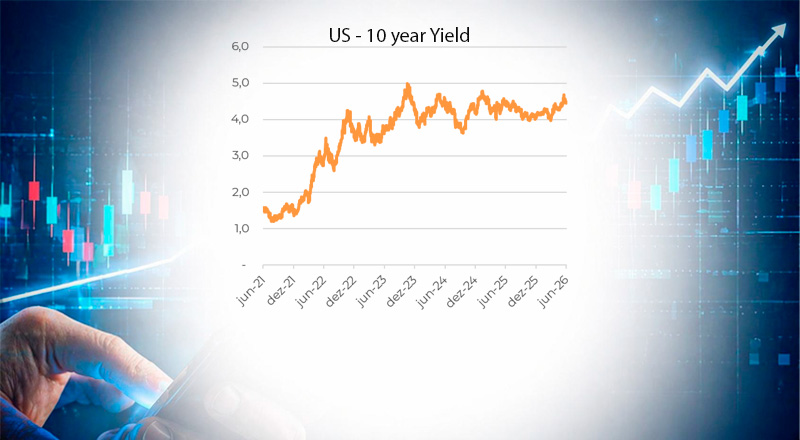
Last week, long-term interest rates in the world’s major economies came under significant pressure. Yields on 10-year U.S. Treasury securities once again approached their highest levels of the past five years, rising above 4.50%. Similar movements have been observed in the United Kingdom, Europe, and Japan.
In addition to concerns about inflation, markets are also responding to the reduction in U.S. government bond holdings by central banks—particularly those of China and Japan—as well as by foreign investors and the Federal Reserve itself. Kevin Warsh, recently appointed Chairman of the Federal Reserve, is a strong advocate of further balance-sheet reduction.
On the geopolitical front, the conflict in Iran continues, with uncertainty surrounding the reopening—or continued closure—of the Strait of Hormuz. At the same time, the United States, China, and the European Union continue to reshape global trade flows. China’s commitment to import US$17 billion per year in U.S. agricultural products may pose risks to Brazilian exports, a key source of foreign exchange earnings for the country. Combined with the recent reduction in foreign participation in Brazil’s stock market (B3), this serves as a warning that the previously favorable external environment may be beginning to reverse, with potential implications for the exchange rate—an important anchor for Brazilian inflation.
On the economic calendar, the main domestic highlights will be the release of the May 2026 IPCA-15 inflation index and Q1 2026 GDP. In the United States, attention will focus on April 2026 inflation data (PCE and core PCE) and an updated estimate of Q1 2026 GDP.
GEOPOLITICS
▪ China and the United States are negotiating reciprocal tariff reductions on goods of equivalent value (minimum US$30 billion), following the summit between Donald Trump and Xi Jinping. China also announced a commitment to import US$17 billion annually in U.S. agricultural products.
▪ China and Russia signed 22 agreements aimed at strengthening bilateral cooperation during Vladimir Putin’s visit to China. The agreements include the construction of a second cross-border railway line, as well as memoranda of understanding on nuclear energy and thermonuclear fusion cooperation.
INTERNATIONAL ECONOMY
▪ Kevin Warsh assumed the presidency of the Federal Reserve, succeeding Jerome Powell. In his inaugural remarks, he reiterated his intention to continue reducing the Federal Reserve’s balance sheet.
▪ China’s industrial production grew 4.1% year-over-year in April 2026, below both market expectations (5.9%) and the 5.7% growth recorded in March. Retail sales also disappointed, increasing only 0.2% year-over-year, compared with expectations of 2.0% and growth of 1.7% in the previous month.
POLITICS
BRAZIL
▪ Voting intentions for Flávio Bolsonaro declined from 47.8% to 41.8% between April and May 2026 following the leak of an audio conversation involving Daniel Vorcaro. During the same period, voting intentions for Lula increased from 47.5% to 48.9%, according to an AtlasIntel/Bloomberg survey.
▪ Four polls released during the week showed that disapproval of President Lula remains elevated: Datafolha (51%), AtlasIntel/Bloomberg (51.3%), Vox Brasil (50.4%), and Gerp (51%).
BRAZILIAN ECONOMY
▪ The IBC-Br, a proxy for GDP calculated by the Central Bank, declined 0.67% between February and March 2026. Nevertheless, growth in Q1 2026 relative to Q4 2025 reached 1.3%, indicating a strong economic recovery during the quarter. Among sectors, industry stood out with growth of 1.3%.
▪ The IGP-10 inflation index slowed from 2.94% in April 2026 to 0.89% in May 2026, according to FGV’s IBRE, driven by agricultural prices, which shifted from +2.30% to -0.26%. The second preview of the IGP-M also decelerated, from 2.64% to 0.86%, reflecting lower pressure from oil and fuel prices.
HIGHLIGHTS (WORLD/BRAZIL): May 18–22, 2026
MARKETS I: EQUITIES AND COMMODITIES
Economy & Markets – Week 21/52-2026
▪ The S&P 500 rose for the eighth consecutive week, gaining 0.88% during the week and 3.7% over the month. The Nasdaq also advanced, rising 1.22% during the week and 7.4% over the month, supported by continued strength in technology stocks. Equity markets in Europe and Japan also posted gains of approximately 3% during the week.
▪ The Ibovespa fell 0.61% during the week, marking its sixth consecutive weekly decline. At 176,209 points, the index stood 11.3% below its all-time high of 198,657 points reached on April 14.
▪ Net foreign inflows into B3 totaled R$43.8 billion over the first 95 trading days of the year, compared with R$20.3 billion during the same period in 2025.
▪ Between April 15 and May 21, foreign investors withdrew R$25.2 billion from B3, explaining an important part of the Ibovespa’s underperformance during a period when most major global equity markets continued to advance.
▪ Volatility in Brent crude oil prices remained elevated. During the week, the Brent futures contract fell 5.24% to US$103.54, while WTI crude declined 8.37% to US$96.60.
▪ Year-to-date gains through May 22 stood at 70.16% for Brent and 68.23% for WTI.
▪ The price of Dutch TTF natural gas declined 2.96% during the week, though it remained up 72.87% year-to-date.
▪ Gold fell 0.68% during the week to US$4,509 per troy ounce, reflecting higher interest rates in major economies. Silver declined 0.59% to US$75.54.
▪ Industrial commodity prices rose during the week, including aluminum (+2.43%), nickel (+2.25%), and copper (+0.83%).
MARKETS II: INTEREST RATES AND CURRENCIES
Economy & Markets – Week 21/52-2026
▪ Yields on 10-year U.S. Treasury securities edged down from 4.59% to 4.56% between May 15 and May 22, after reaching 4.67% on May 19. Inflation remains an important driver, but structural factors are also exerting significant influence on government bond markets.
▪ In Brazil, the interest-rate curve partially reversed the increase observed the previous week, which had been driven by international interest rates and the domestic political environment. Polls released during the week showed that both disapproval and rejection rates for President Lula remain elevated. The January 2029 DI contract declined from 14.16% to 13.85%.
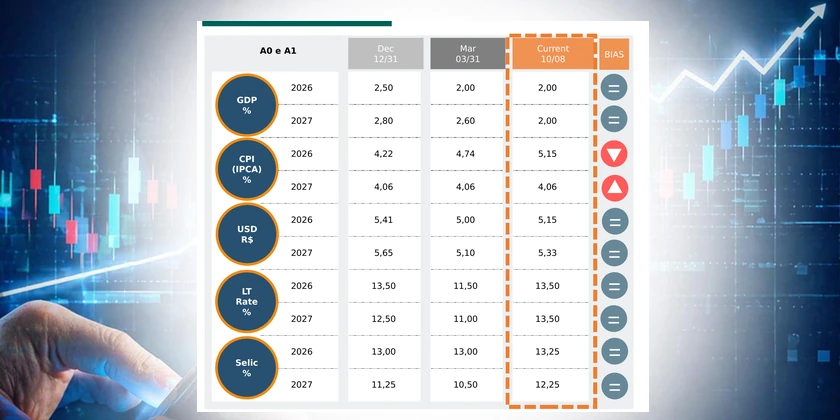
▪ In the May 16 Focus Survey, expectations for IPCA inflation at the end of 2026 stood at 4.92%, above the upper limit of the inflation target range. At the end of February 2026, the same expectation was 3.91%.
▪ Expectations for IPCA inflation at the end of 2027 remained at 4.0%, compared with 3.79% at the end of February 2026.
▪ The DXY U.S. Dollar Index was unchanged during the week amid pressure in bond markets. The euro (EUR) depreciated 0.19%, while the Japanese yen (JPY) fell 0.28%. Among the major currencies, only the British pound (GBP) appreciated, gaining 0.80%.
▪ Most emerging-market currencies appreciated against the U.S. dollar, with the exceptions of the Argentine peso (ARS) and the Turkish lira (TRY).
▪ The Brazilian real (BRL) appreciated 0.37% during the week to R$5.04 per U.S. dollar, remaining above the R$5.00 level.
▪ The 21-day moving average of Brazil’s foreign-exchange flow remained positive at US$12.9 billion through May 15. During the period, the commercial flow increased from US$7.0 billion to US$10.8 billion, while the financial flow rose from US$0.4 billion to US$2.2 billion.
CLIMATE AND ENVIRONMENT
▪ The U.S. National Oceanic and Atmospheric Administration (NOAA) estimates an 82% probability of El Niño between May and July 2026 and a 96% probability between December 2026 and February 2027—well above the 40% probability projected in early March for the May–July period.
▪ NOAA also estimates a 37% probability of a very strong El Niño event between November 2026 and January 2027, which would imply prolonged droughts in Northern and Northeastern Brazil and intense rainfall in Southern Brazil.
AGRIBUSINESS (I)
▪ The Chamber of Deputies approved the merits of two bills: PL 715/2023, which allows seasonal agricultural workers to hold formal employment contracts without losing social benefits, and PLP 262/2019, which grants cooperatives access to the FDNE, FDA, and FDCO regional development funds.
▪ The Chamber also approved expedited consideration for six additional bills: PL 2143/2025, PL 3123/2025, PL 5900/2025, PL 2827/2025, PLP 34/2026, and PLP 1122/2024.
AGRIBUSINESS (II)
▪ Brazilian agricultural exports totaled US$54.59 billion between January and April 2026, a record for the period, according to the Ministry of Agriculture. Key contributors included soybeans (US$20.15 billion), meat products (US$11.14 billion), forest products (US$5.31 billion), and coffee (US$4.51 billion).
▪ China—the main destination for Brazilian agricultural exports—committed to importing US$17 billion annually in U.S. agricultural products between 2026 and 2028. It is also expected to increase imports of U.S. meat and poultry products.
FOREIGN DIRECT INVESTMENT IN BRAZIL
▪ According to the Central Bank of Brazil, the average share of annual foreign direct investment (FDI) directed toward the services sector increased from 50% between 2016 and 2020 to 61% between 2021 and 2025, with financial services accounting for a significant portion of the increase. The share allocated to industry declined from 31% to 27%, while the share directed to the primary sector fell from 18% to 11%.
▪ Foreign direct investment in Brazil totaled US$77 billion in 2025, a 23% increase over 2024, making Brazil the third-largest recipient of FDI globally, behind only the United States and China, according to the OECD.
BRAZILIAN INVESTMENT IN PARAGUAY
▪ Approximately 230 Brazilian companies have relocated to Paraguay since 2007 under the country’s Maquila Law. This represents roughly 70% of the more than 320 foreign companies established in Paraguay during the period.
▪ Estimates indicate that labor costs (wages and payroll charges) in Paraguay are 30% to 40% lower than in Brazil, while the standard workweek is 48 hours.
CIVIL AVIATION
▪ Airlines reduced flight capacity in May 2026, with scheduled flights falling from 67,980 to 65,100, below the 66,300 flights recorded in May 2025. The reduction is equivalent to 93 fewer flights per day. Estimates point to a further reduction of 121 daily flights in June 2026, reflecting higher aviation fuel prices, which account for roughly one-third of airline operating costs.
▪ In April 2026, Brazil recorded 8,006,624 domestic passengers (+1.1% year-over-year and a new record) and 2,224,730 international passengers (+4.2% year-over-year).