
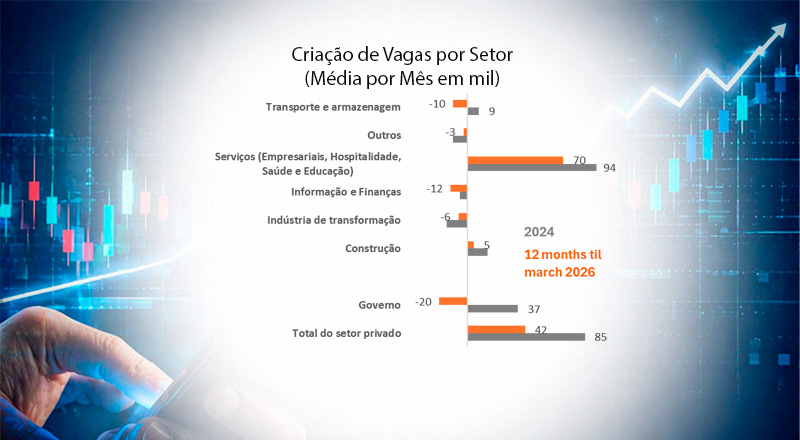
US – Payroll:  Public Sector Accounts for 57% of Job Losses Between 2024 and Early 2026

Download File
Reading time: 2 minutes
Tempo de leitura: 2 minutos
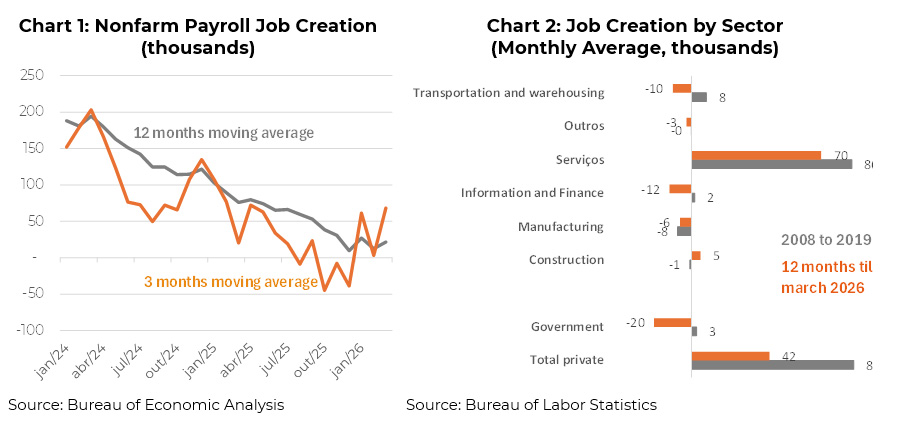
  • The payroll data came in reasonably strong in March, corroborating the view that job creation is returning to more normal levels. Nonfarm payrolls increased by 178k and the unemployment rate remained stable at 4.3%. The Gulf war, now lasting over a month, is likely to generate inflation and slow the pace of economic growth. Chart 1 shows that the worst is already behind us on a 12-month cumulative basis, while recent monthly readings appear significantly more benign.
  • The lion’s share of the labor market deterioration observed throughout 2025 was associated with job losses in the public sector. The monthly average of 3k jobs added in the recent past (+37k in 2024 alone) shifted to a contraction of 20k jobs on the same basis when considering the last 12 months (see Chart 2).
  • The recent recovery in job creation has been more pronounced in the most dynamic segment of the economy, including professional and business services, hospitality, leisure, education, and healthcare. Other sectors such as manufacturing and construction have continued to show stability in employment levels.
  • Considering a labor force of around 170 million people, growing at an average pace of 1% per year, we estimate that job creation of approximately 140k per month in the nonfarm sector would be sufficient to maintain equilibrium in the labor market.
  • The latest data reinforced the message from members of the Monetary Policy Committee regarding caution on the need for rate cuts. The oil shock and its first- and second-round effects on prices are likely to become increasingly central to monetary policy discussions.
Leave a Reply

Your email address will not be published. Required fields are marked *

The hidden game of the market that few dare to expose.

Discover how influence and manipulation shape decisions every day — and learn to see what most overlook.

Newsletter Market Cruncher

Get strategic market insights delivered straight to your inbox.

Stay Informed

Related Articles

Oil Shock and Inflation: Brazil x US

A persistently expansionary fiscal stance, a tighter output gap, and, above all, a monetary policy framework characterized by lower credibility help explain why 10-year inflation expectations have risen more sharply and remained more persistent in Brazil than in the United States.

Oil Prices Retreat – Inflation Expected to Turn Temporarily Negative – Pezco Monthly Review

The recent decline in oil prices and a broad range of industrial input costs may contribute to a gradual disinflationary process over the coming months, particularly in advanced economies.

Museum of Old Ideas (by Tatiana Pinheiro)

The arithmetic is straightforward. The politics are not. The adjustment required to stabilize public debt is substantial. The most frequently discussed proposals in Brazil's fiscal debate are well known and have been debated by governments across the political spectrum, underscoring the difficulty of translating technical solutions into political reality.

Newsletter Market Cruncher

Receive strategic market insights directly to your email.

Market Cruncher uses your contact information to send you relevant content.
You can unsubscribe at any time.