
Brazil- External Accounts in a Comfortable Position Amid the Oil Shock

Download File
Reading time: 2 minutes
Tempo de leitura: 2 minutos
  • Current account transactions recorded a deficit of USD 5.6 billion in February 2026. Foreign direct investment (FDI) posted net inflows of USD 6.8 billion. Portfolio investment in the domestic market registered net inflows of USD 5.4 billion, of which USD 2.8 billion in equities and investment funds and USD 2.6 billion in debt securities. Over the twelve months ending last month, portfolio investment in the domestic market totaled net inflows of USD 29.3 billion.
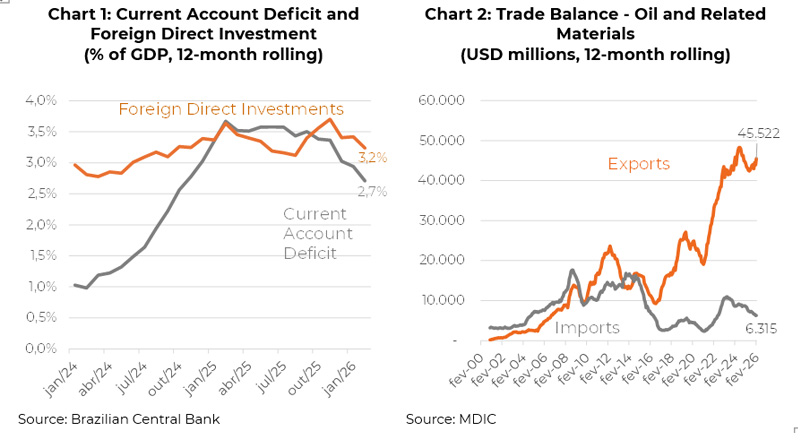
  • Although not yet incorporating the period following the oil shock, external accounts data indicate that Brazil is well positioned to weather the international crisis. First, the current account deficit, at 2.7% of GDP on a 12-month basis through February, has narrowed significantly from the 3.6% level prevailing in mid-2025 (Chart 1).
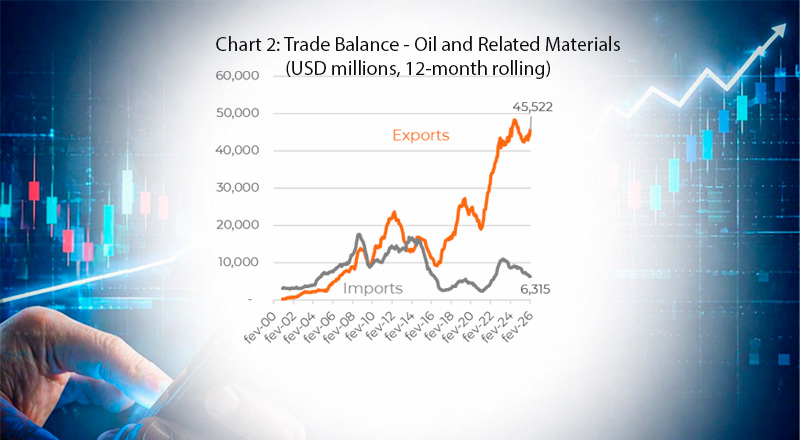
  • Second, the positive balance between oil exports and imports continues to expand (Chart 2). If prices average USD 100 per barrel (Brent) through year-end, the trade balance could receive a positive boost of USD 13 billion in 2026 alone.
  • Indeed, oil is already among Brazil’s main export products, and the trend points to further growth, at least through 2028. In the context of a price shock stemming from the conflict in Iran, the country’s position as a major producer is also likely to have a positive impact on fiscal accounts. For every USD 10 increase in oil prices, the impact on net public sector revenues could reach BRL 11 billion over a one-year horizon.
Leave a Reply

Your email address will not be published. Required fields are marked *

The hidden game of the market that few dare to expose.

Discover how influence and manipulation shape decisions every day — and learn to see what most overlook.

Newsletter Market Cruncher

Get strategic market insights delivered straight to your inbox.

Stay Informed

Related Articles

Oil Shock and Inflation: Brazil x US

A persistently expansionary fiscal stance, a tighter output gap, and, above all, a monetary policy framework characterized by lower credibility help explain why 10-year inflation expectations have risen more sharply and remained more persistent in Brazil than in the United States.

Oil Prices Retreat – Inflation Expected to Turn Temporarily Negative – Pezco Monthly Review

The recent decline in oil prices and a broad range of industrial input costs may contribute to a gradual disinflationary process over the coming months, particularly in advanced economies.

Museum of Old Ideas (by Tatiana Pinheiro)

The arithmetic is straightforward. The politics are not. The adjustment required to stabilize public debt is substantial. The most frequently discussed proposals in Brazil's fiscal debate are well known and have been debated by governments across the political spectrum, underscoring the difficulty of translating technical solutions into political reality.

Newsletter Market Cruncher

Receive strategic market insights directly to your email.

Market Cruncher uses your contact information to send you relevant content.
You can unsubscribe at any time.