- The Central Bank of Brazil released today the data on corporate and household indebtedness. The stock of credit operations in the National Financial System (SFN) reached BRL 7.2 trillion in March, an increase of 9.7% over 12 months (against an inflation of 4.1%). The highlight remains the expansion of directed credit, which grew 12.3% over the same period.
- Corporate indebtedness remains elevated (54.9% of GDP), although below historical peaks (around 57%). Household debt, on the other hand, has never been higher (38% of GDP). Credit costs are extremely high (average of 17.5% p.a. for corporates and 28.2% p.a. for households), and delinquency continues to reach record levels (2.7% for firms and 5.3% for households).
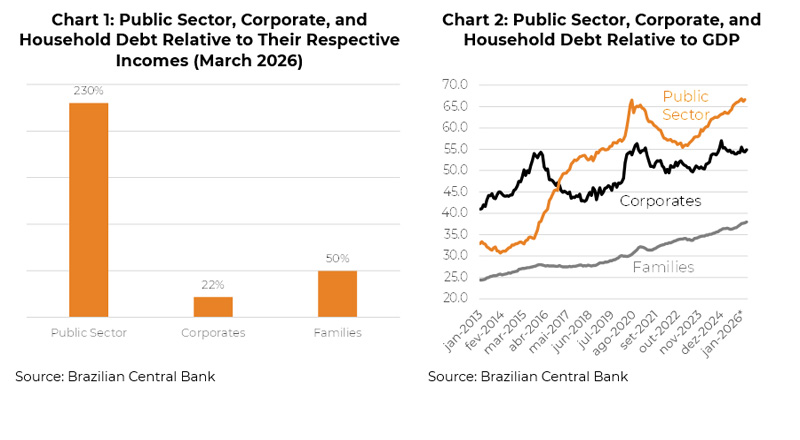
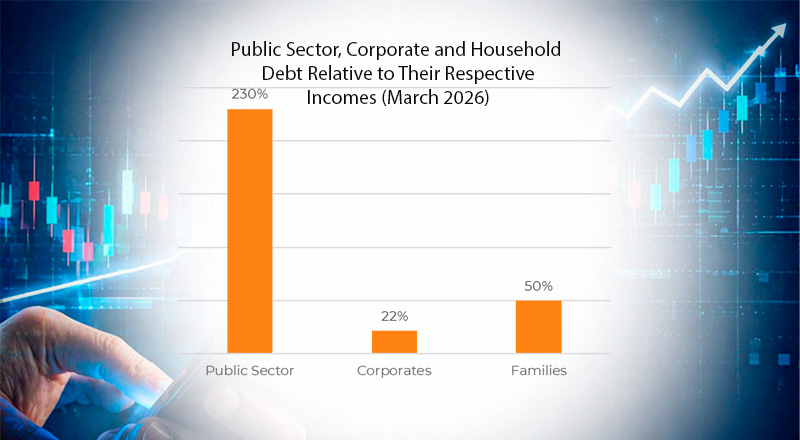
- Now consider the following: household debt relative to annual income stands at 49.9%. For companies, we estimate a ratio of roughly 21.7%. For the public sector, however, the figure reaches an astonishing 230% (a debt of 79.2% of GDP divided by the 34.4% tax burden). Chart 1 summarizes these figures.
- Chart 2 shows the recent dynamics of debt-to-GDP ratios for households, corporates, and the public sector.
- In other words, the government is right to be concerned about the financial situation of Brazilian households, especially given the strong electoral appeal of the issue. The official strategy is to ease the financial burden on lower-income groups through subsidies (the “Unshackling” program). The remaining question is: who will unshackle government’s own debt? The answer: you.