
GDP growth of 0.5% q/q in the second quarter and 2.0% y/y does not, at first glance, look particularly weak. But there is something noteworthy beneath the headline numbers: my estimates suggest that the output gap has closed and moved, albeit marginally, into negative territory. This is somewhat earlier than the Central Bank of Brazil had anticipated, as it expected the gap to close over the coming quarters and turn negative in 2027.
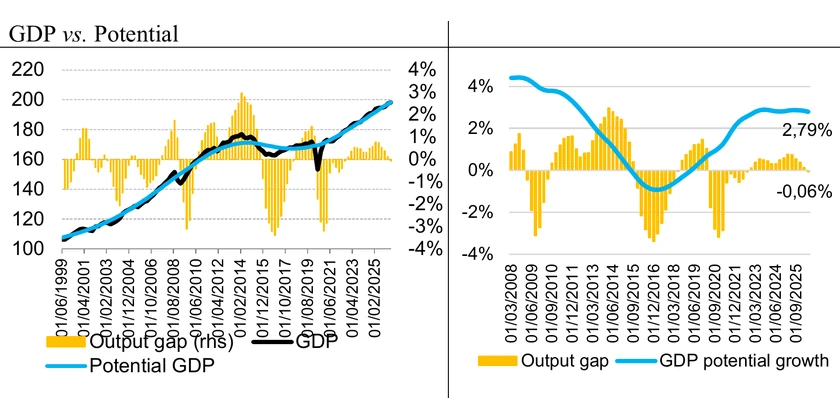
It is worth emphasizing that potential GDP and the output gap—the difference between actual and potential GDP—are not directly observable, and estimates are therefore subject to considerable uncertainty. Even so, a marginally negative output gap provides an initial indication of emerging economic slack. This raises two questions: did the output gap close because aggregate demand slowed, or because potential GDP increased? And what does this imply for the pace of monetary easing?
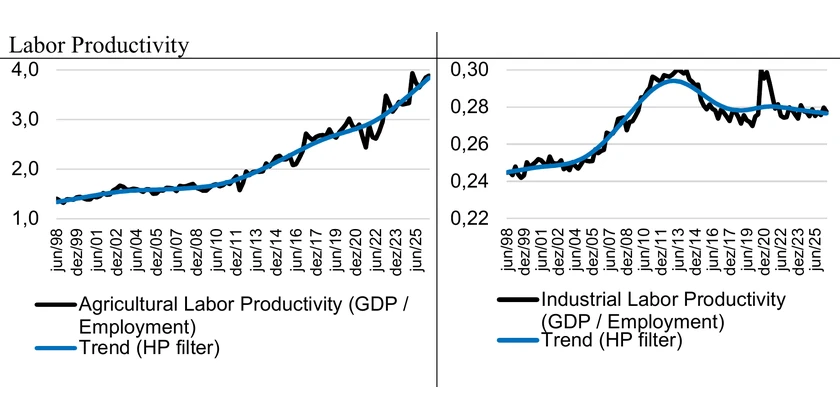
Productivity data call for caution regarding the hypothesis of stronger potential GDP growth. Labor productivity, measured as output in each sector relative to its employed population, shows gains that are heavily concentrated in agriculture. Over the past two decades, productivity in the sector has more than doubled and remains on an upward trend. By contrast, productivity in industry has remained broadly stagnant. In services, which account for the largest share of the economy, productivity increased until the beginning of the last decade, subsequently declined, and has remained broadly stable in recent years.
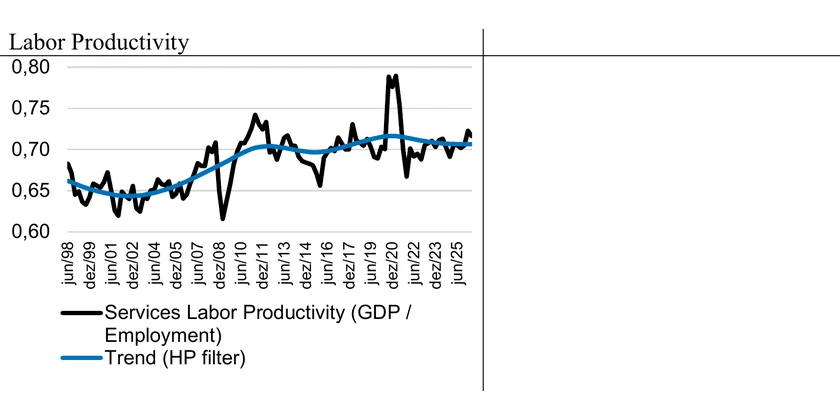
If Brazil were experiencing a broad-based acceleration in productivity, one would reasonably expect to see more widespread signs across industry and, especially, services. It is therefore difficult to find evidence in these data of broad-based productivity gains capable of sustaining a meaningful acceleration in potential GDP growth.
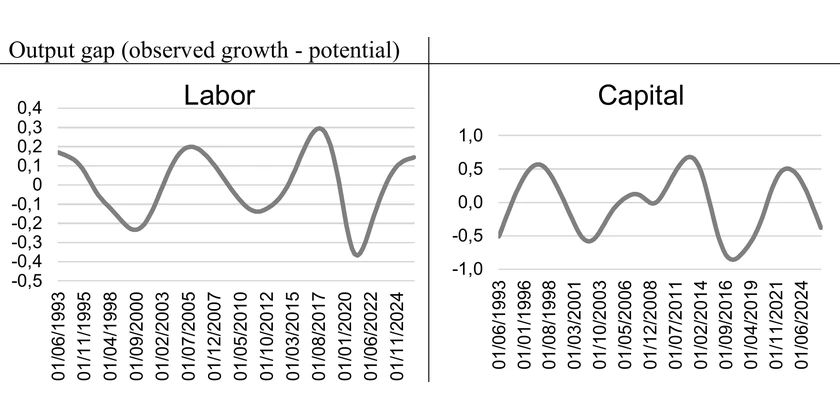
Another development helps explain the closing of the output gap. According to my estimates of factor utilization gaps, the labor gap has remained positive since 2023, reflecting labor utilization above trend and a tight labor market. The opposite has occurred with capital: the capital utilization gap has declined steadily over this period and moved into negative territory in the second half of 2025. This dynamic suggests that recent growth has relied relatively more heavily on labor utilization, while capital utilization has lost momentum. Combined with the absence of broad-based productivity gains, this supports the interpretation that the closing of the output gap reflects weaker demand rather than an acceleration in potential growth.
Monetary policy helps explain this dynamic. The ex-ante real interest rate, measured by the one-year interest rate deflated by expected inflation over the following 12 months, has remained above 8% since the third quarter of 2024 and has barely declined even as the Selic easing cycle has progressed. For nearly two years, therefore, the real interest rate has remained well above the 5% level estimated by the Central Bank of Brazil for the neutral real rate.
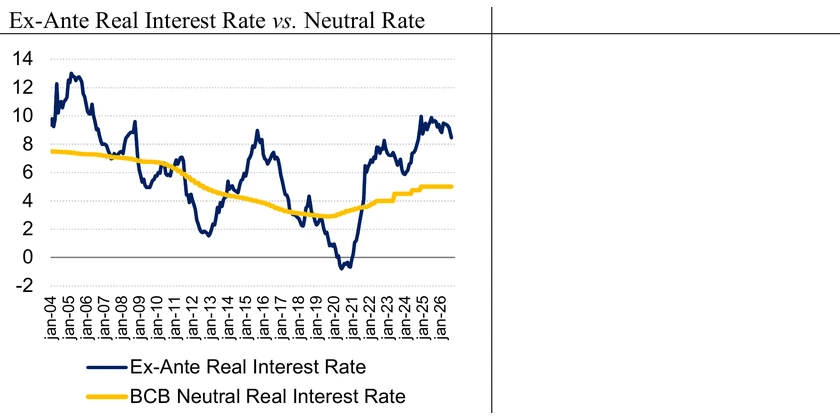
Such a restrictive monetary policy stance is consistent with the weakening in capital utilization and also helps explain the mounting financial pressure on firms. According to Serasa Experian, filings for court-supervised corporate restructuring increased by 18% in 2025. Even so, the resilience of economic activity for so long despite such high real interest rates has been noteworthy, particularly during a period also characterized by expansionary fiscal and quasi-fiscal policies.
Interest rates affect financial conditions and credit first, followed by consumption and investment, and ultimately inflation. Assuming a transmission lag of around 18 months, a significant portion of the effects of the monetary tightening that began in 2024 should become more visible precisely in 2026. The decline in the capital utilization gap and the closing of the output gap are consistent with this transmission mechanism.
Does weaker demand create room for the easing cycle to continue? Yes. This does not mean, however, that interest rates can fall quickly. The output gap is only marginally negative, its estimation is subject to considerable uncertainty, and the labor market remains tight. Moreover, productivity and potential growth remain constrained. Monetary easing should therefore proceed gradually, with the policy stance remaining restrictive, so as not to jeopardize the costly disinflation process achieved thus far.