US – PPI and Import Prices – Indicators Ease as Oil Prices Retreat, but the Overall Picture Remains Concerning

Download File
Reading time: 2 minutes
Tempo de leitura: 2 minutos

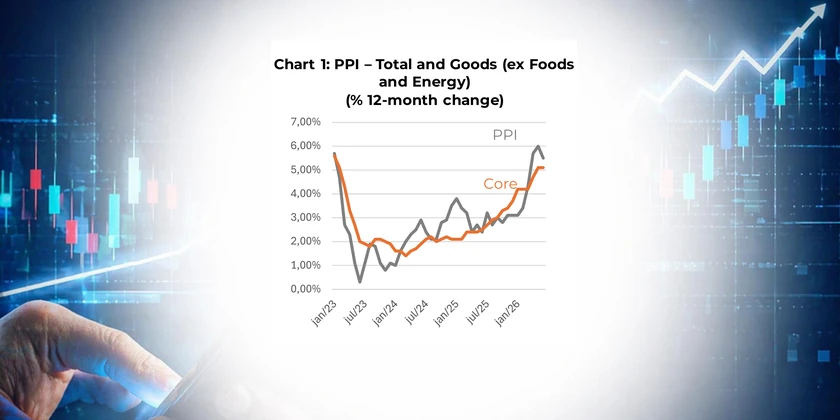
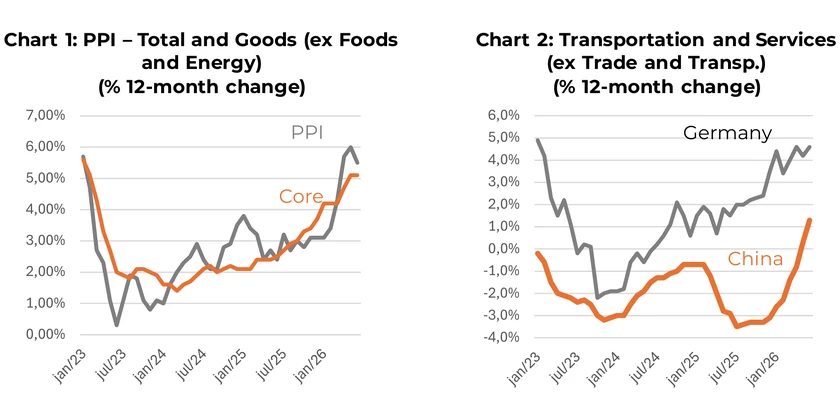
Final demand PPI declined in June but remained elevated at 5.5% year-over-year (vs. 6.0% in May).
The narrow core measure, which excludes food, energy, and trade services, stood at 5.1% (see Chart
1).

  • The overall picture remains concerning because it points to a significant upward shift in
    producer inflation, from roughly 2%–3% at the end of last year to around 5% in recent readings.
    Even if oil prices continue to retreat, wholesale inflation is unlikely to return to its previous
    range.
  • The data clearly indicates that the tariff shock has been passed through to producer prices,
    although much less so to consumer prices. Import prices rose 7.1% over the 12 months through
    June. While part of this increase reflects higher oil prices, import costs from countries such as
    Germany, Japan, and China (which are not major energy exporters) have also continued to
    accelerate (see Chart 2).
  • The Producer Price Index (PPI) for final demand fell 0.3% in June, largely driven by lower energy
    prices. Gasoline prices declined 12.0%, accounting for nearly two-thirds of the 1.4% drop in goods
    prices. Final demand services, meanwhile, increased 0.2% during the month.
  • The underlying details continue to point to persistent inflationary pressures outside the energy
    sector. Prices for goods excluding food and energy accelerated to 5.1% year-over-year, while plastic
    products rose 1.6% during the month. This provides further evidence that cost pressures are still
    being passed through at the wholesale level.
Leave a Reply

Your email address will not be published. Required fields are marked *

The hidden game of the market that few dare to expose.

Discover how influence and manipulation shape decisions every day — and learn to see what most overlook.

Newsletter Market Cruncher

Get strategic market insights delivered straight to your inbox.

Stay Informed

Related Articles

Employment and Income Across States and Municipalities: A Snapshot

Brazil's national employment and income statistics conceal enormous regional inequality: states and capitals live with very different realities of employment, income, and informality — which reinforces the importance of programs such as Bolsa Família precisely where poverty is greatest.

GDP 3/3 – The Adjustment Is Working. Two Risks to Monitor.

The slowdown in domestic consumption shows that monetary policy has worked, with the real interest rate still elevated. Pezco projects the Selic at 13.25% by end-2026 — but two risks, fiscal and supply-side, require monitoring.

The International Oil Shock and Brazil’s Fiscal Uncertainties Persist

Pezco's September Economic Scenario: oil above US$ 100 reignites near-term inflation risk and the fiscal picture stays center stage. GDP decelerates, the IPCA offers temporary relief, and debt — above all its cost in Brazil — is a concern.

Newsletter Market Cruncher

Receive strategic market insights directly to your email.

Market Cruncher uses your contact information to send you relevant content.
You can unsubscribe at any time.