The combination of high public debt and high interest rates, prevalent across major economies, tends to raise the probability of financial instability. The risk lies not only in public indebtedness itself, but in who finances those securities, with how much leverage and under what collateral conditions. That is what the IMF pointed to in its latest Financial Stability Report.
Government securities are the backbone of financial institutions’ short-term funding operations, of arbitrage strategies and of leveraged positions. When long-term rates rise, losses and margin calls can force sales that push yields even higher.
Between 2013 and 2025, gross debt rose sharply in the United States (from around 100% to roughly 124% of GDP). Over the same period, hedge funds’ gross assets more than tripled, while these funds’ share of non-bank financial assets went from 0.6% to 4.5%.
The proximity of the fiscal abyss is not the preserve of the United States alone. Economies such as the United Kingdom, France, Japan and Brazil are also examples of vulnerability that can help feed back into crises involving asset prices.
Introduction
The central theme of this note is the risk that high public indebtedness and high interest rates amplify global financial instability through leveraged operations. As in the mortgage market of a decade and a half ago, the problem lies less in the asset itself and more in the leverage built on top of it.
Elevated Debt, High Interest Rates and Leverage: How the Risk Is Amplified
Sovereign debt, on its own, does not define the risk of instability: countries with very high liabilities can coexist with functioning markets for long stretches. What changes the picture is the combination of three elements: a large stock of securities that must be rolled over, higher long-term rates that make refinancing more expensive, and a financial system in which much of that debt is carried by leveraged intermediaries that use these same securities as collateral to obtain funding.
US hedge funds’ gross assets have more than tripled since the last decade, while these funds’ share of total non-bank financial assets rose from 0.6% in 2008 to 4.5% in 2024. In normal times, this presence tends to support market liquidity and efficiency. Under stress, however, it can amplify price distortions and liquidity pressures. The financial system’s vulnerability potentially stems from three sources: excessive leverage, fragile investor funding and concentrated positions (crowded trades).
Leverage amplifies the adverse effects of concentrated positions and of investor redemptions, through the widening of spreads when positions in sovereign securities are unwound. These securities are the main asset of those very operations, so that very high debt and rising long-term rates end up directly affecting the size of the stock, thereby creating a vicious circle.
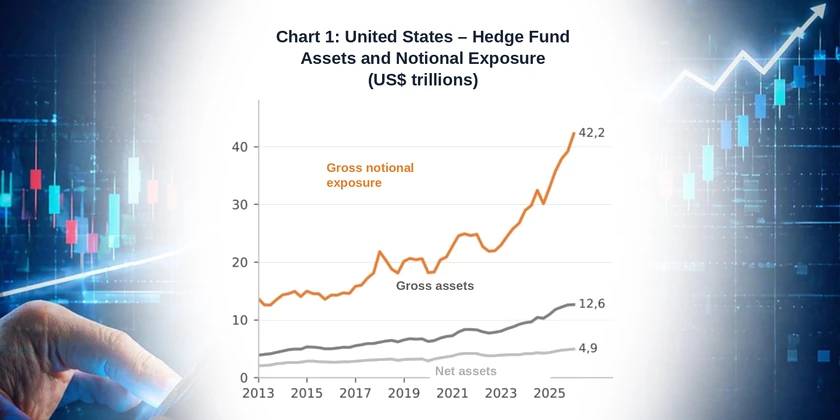
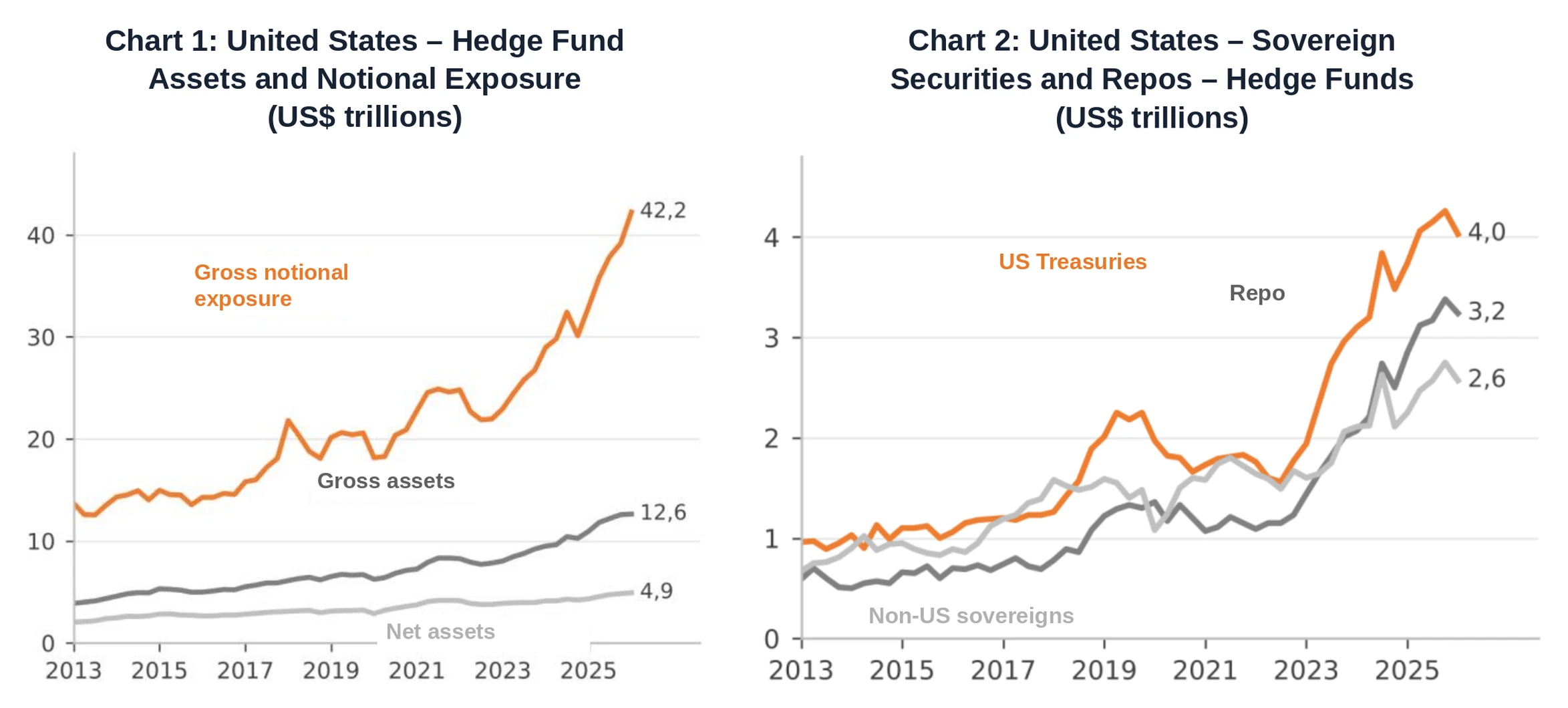
Many investment and funding strategies rely on synthetic leverage obtained through derivatives. To give a sense of scale, gross notional exposure to US Treasury securities, which includes off-balance-sheet derivatives, tripled from US$13 trillion in 2013 to more than US$40 trillion in early 2026 (Chart 1).
In many cases, the funding of hedge funds’ investment strategies comes from operations collateralized by public debt. Repo credit (sale contracts with a repurchase commitment) involving institutional investors rose from US$0.6 trillion to US$3.2 trillion over the past decade, while exposure to US Treasury securities increased from US$1.0 trillion to US$4.0 trillion (and from US$0.7 trillion to only US$2.6 trillion in other countries’ sovereigns, Chart 2).
The unwinding of leveraged or concentrated positions transmits stress beyond the market initially affected, because the funds sell other assets to raise cash. Global trading activity, cross-border funding, collateral linkages and offshore vehicles amplify this contagion, through a feedback loop involving deleveraging, asset sales and tighter financial conditions. The starting point can be small: margin calls, which require additional collateral when the value of assets falls, can trigger the unwinding, and concentrated positions can reverse abruptly.
The Fiscal Abyss – United States, United Kingdom, France, Brazil and Japan
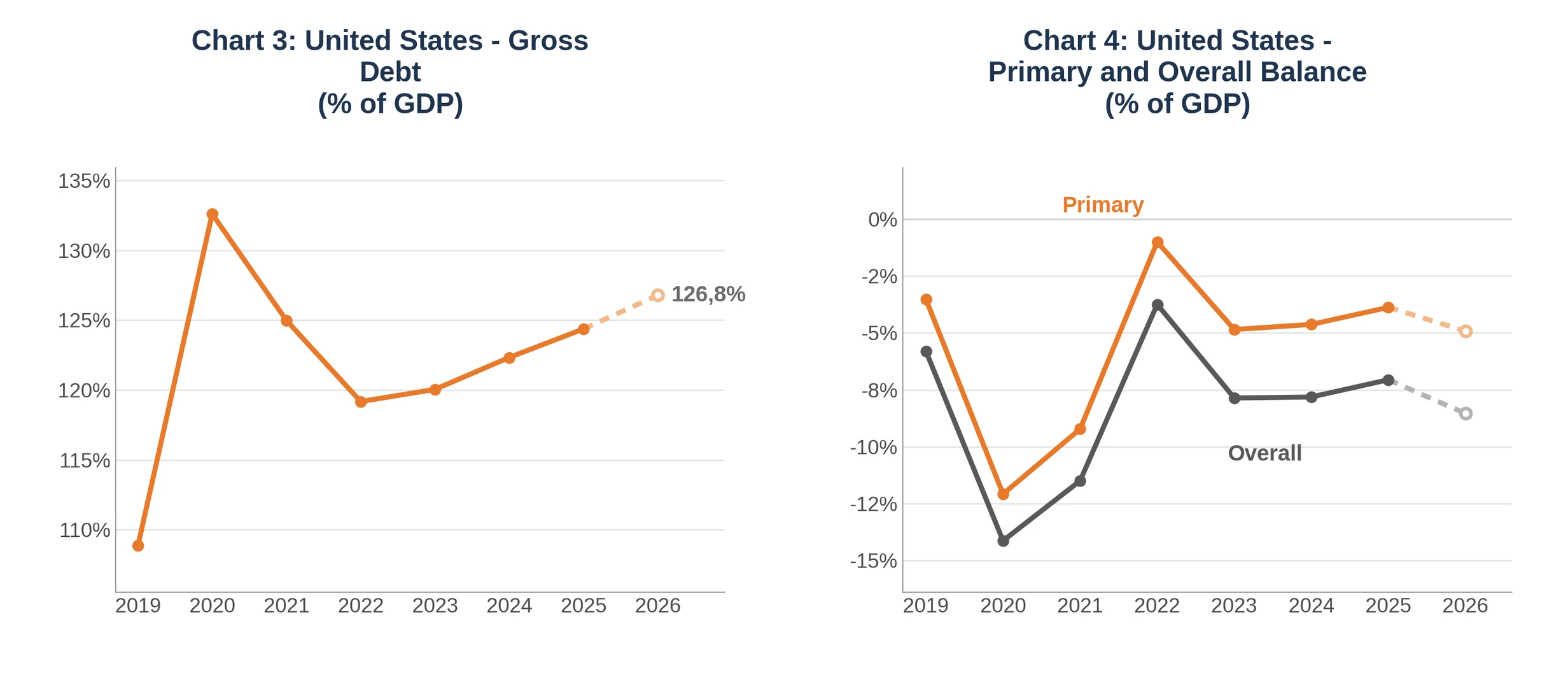
The general government gross debt of the United States, as a share of GDP, went from 108.8% in 2019 to 124.4% in 2025, a deterioration that occurs even against a backdrop of resilient activity. Economic growth and higher tax collection have not proven sufficient to contain the worsening of fiscal indicators. The headline (nominal) deficit reached around 7% of GDP last year, while the primary deficit came close to 4% of GDP. To gauge the impossibility of stabilizing the debt through economic activity alone, a growth rate of about 6% a year would be needed to contain the relative debt. The Treasury’s issuance and refinancing needs remain large, and the rise in long-term rates over the period increases the cost of financing that stock, with investors demanding higher yields. The US case is central to the theme of this note because, as we have seen, Treasury securities are the main collateral for repo-funded operations and the basis of leveraged arbitrage strategies: that is where the rise in long-term rates most directly turns into losses and collateral demands.
The main risk to the scenario would be a combination of persistent inflation, disappointment with investment in technology and the continuation of large deficits, which would simultaneously raise sovereign yields and private credit spreads. Abrupt changes in collateral requirements or in the funding of leveraged positions could intensify securities sales and produce a financial tightening that would hit the US economy and make access to resources more expensive in other countries.
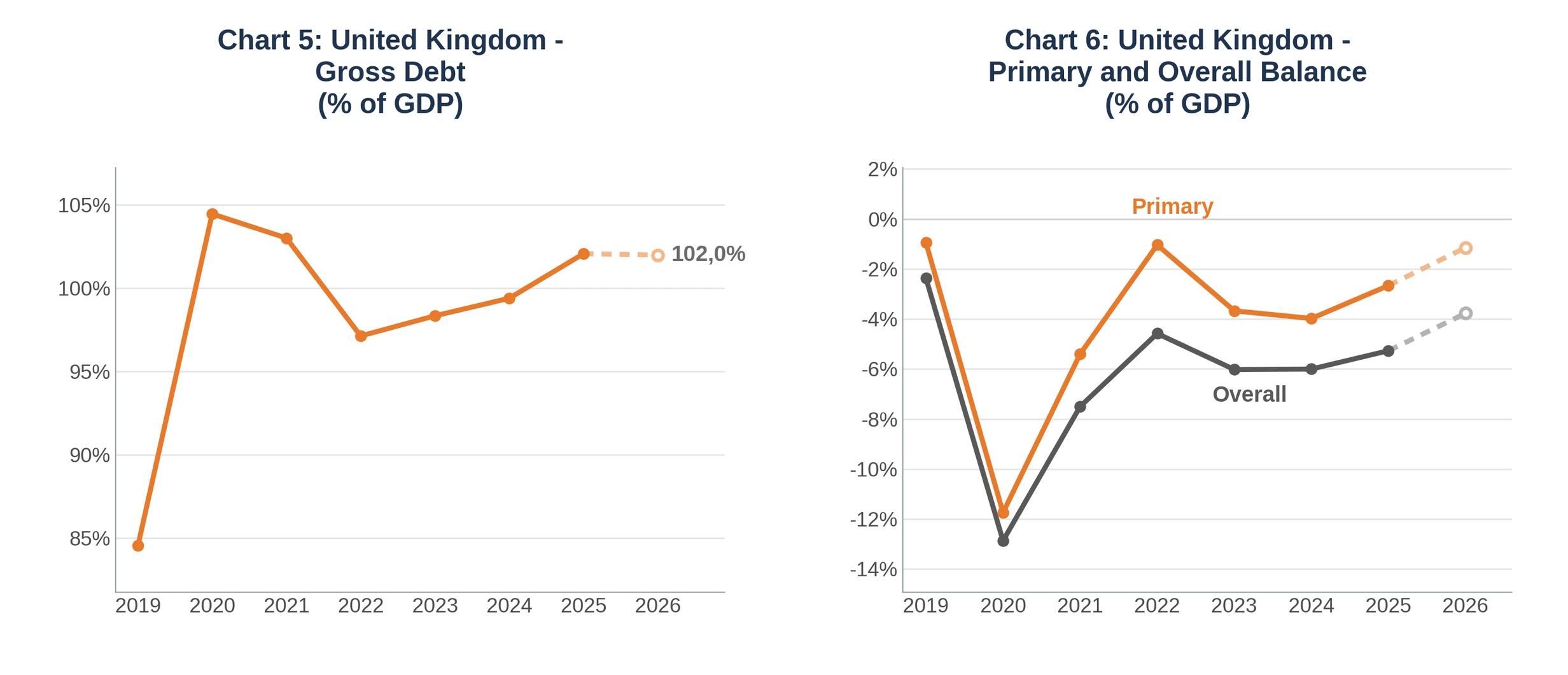
In the United Kingdom, gross debt reached 102.3% of GDP in 2025, with an estimate of 104% for 2026. The primary and overall balances show visible improvements, but ones that are insufficient to contain the expansion of liabilities. High interest rates limit budgetary relief and continue to weigh on consumption and investment, while moderate growth leaves little room to offset revenue shortfalls. In the market, long-term rates are higher, which makes the British case illustrative of the channel through which fiscal problems are transmitted to financial assets. Liquidity in the bond market has improved recently, which is a relevant buffer, but the investor base is heavily institutional, with pension funds and other investors whose liquidity depends on the very stability of the value of those securities.
A sharper rise in government bond yields could generate urgent cash needs among pension funds and other investors, prompting concentrated sales at precisely a moment when the market is under pressure. In that scenario, the budget loses room to respond while households and firms face expensive credit and weaker activity.
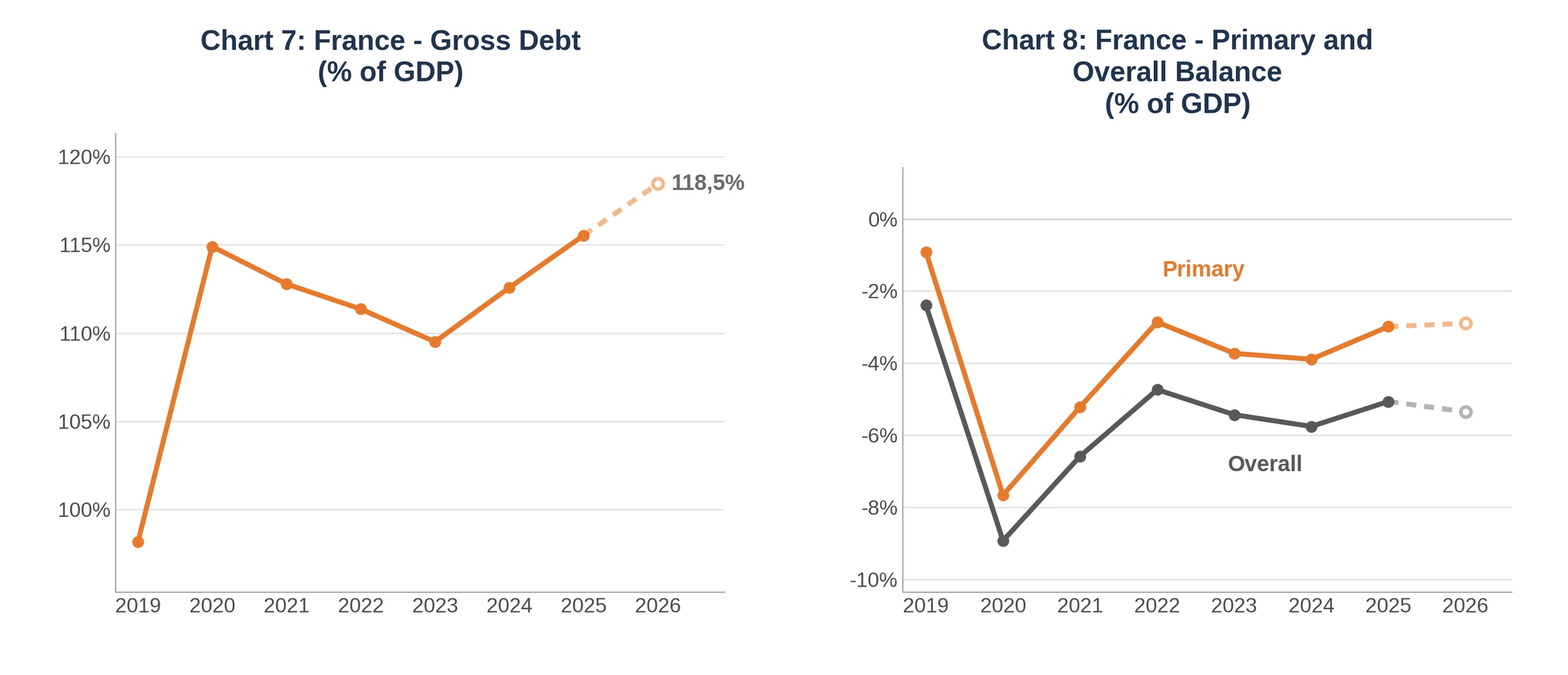
If the social context in France looks dramatic, the fiscal one is not much better. That is natural, since these two situations are generally correlated. Gross debt is set to hit 120% of GDP in 2026. It is one of the most persistent upward trajectories among developed economies, in a context of weak growth that limits the expansion of revenue. The deficits are high: 3% of GDP for the primary balance and 5% for the overall balance. As we have stressed, rising interest rates aggravate the pressure on the budget, as the debt is rolled over and the premium required to finance it reaches historically high levels when compared with those of other economies that share the same currency, as is the case of Germany, for example.
On the risk front, the loss of credibility in carrying out the fiscal adjustment, in a context of social tension and populist parties at both ends of the political spectrum contending for power, means that the tendency is for credibility in a reform plan to remain low. The good news is that the European framework offers protection against contagion, but it does not remove the need to correct the national accounts.
In Brazil the mood is “make or break.” The debt trajectory is unsustainable, as is the interest rate. Either the government to be sworn in next year delivers a credible adjustment right away, or the market will demand it through the vicious circle of interest rates – asset prices – indebtedness described in the first section. With a headline deficit running at 8% of GDP, gross debt could hit 100% within a few years.
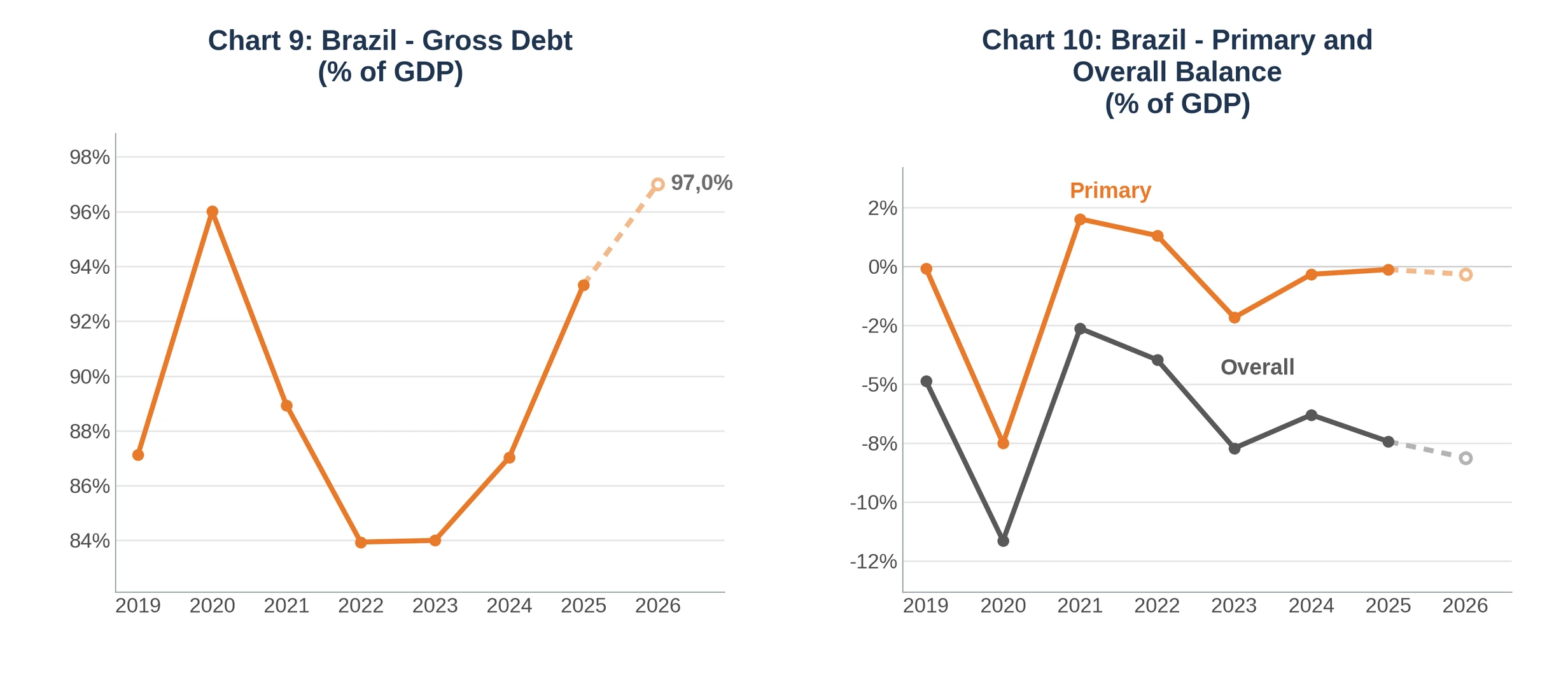
Restrictive monetary policy pushes up the cost of credit, and the fiscal picture is an obstacle to lower interest rates. As an emerging economy, the country is sensitive to the global appetite for risk, and a rise in external interest rates or flight-to-safety moves by international investors tend to make access to resources even more expensive.
The greatest risk lies in the exchange rate, which in the event of depreciation would reduce the room for interest-rate cuts and keep the cost of rolling over the debt stratospheric. A further widening of corporate spreads could aggravate the difficulties of companies with refinancing coming due and of indebted households.
In terms of the recent dynamics of indebtedness, Japan is an exception, with a decline to 206% of GDP in 2025 after having reached 228% in 2020. But the level is extremely high, which makes the public sector even more sensitive to an adverse interest-rate cycle. The fiscal result does not keep pace with the improvement in the debt-stock indicator. The primary deficit is expected to reach 1.7% in 2026 (with an estimate of 2% for the overall balance). Annual financing remains demanding, and expensive energy adds pressure to the public accounts.
As in the United States, yields on ten-year Japanese bonds have risen, volatility has increased and the trading costs of long-dated bonds have widened, as monetary normalization removed the support that kept rates compressed.
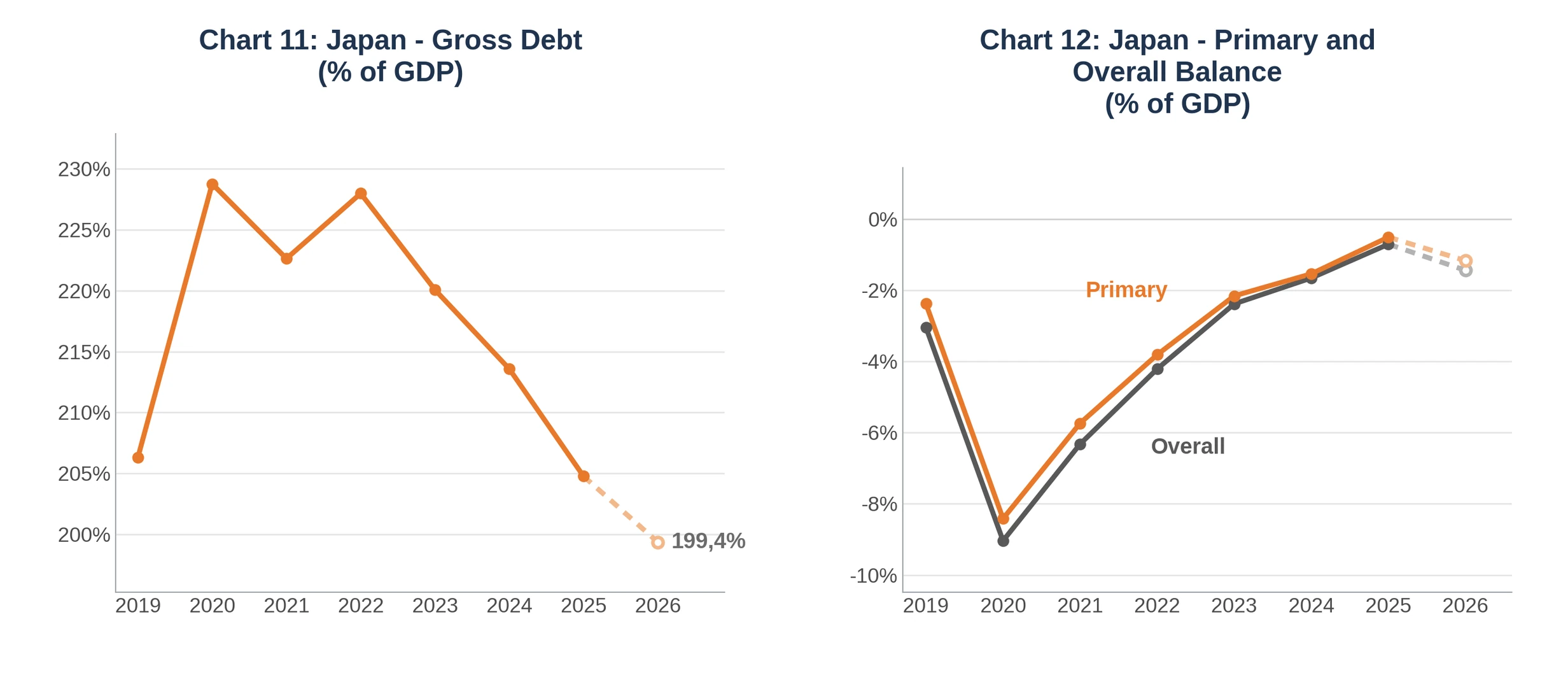
On the risk front, Japan illustrates how leverage can transmit an interest-rate shock beyond the country’s borders: the unwinding of leveraged positions funded in yen (the so-called carry trade) could pose a risk of international contagion in a volatility scenario. Forced sales and financial tightening can occur even without a crisis of confidence in the public debt.