Summary and Conclusions
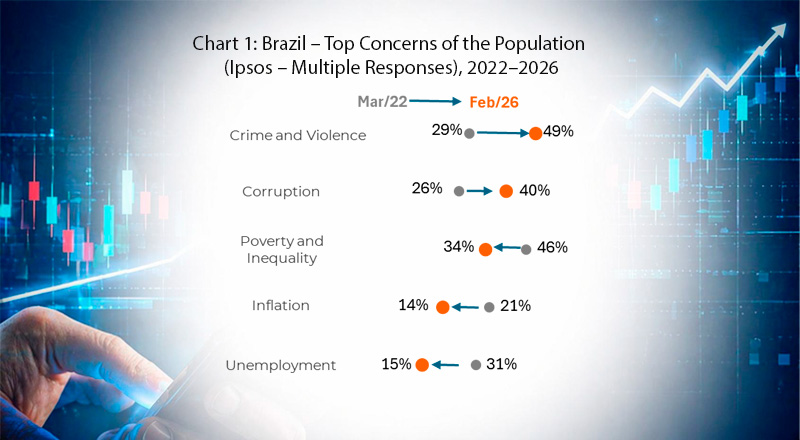
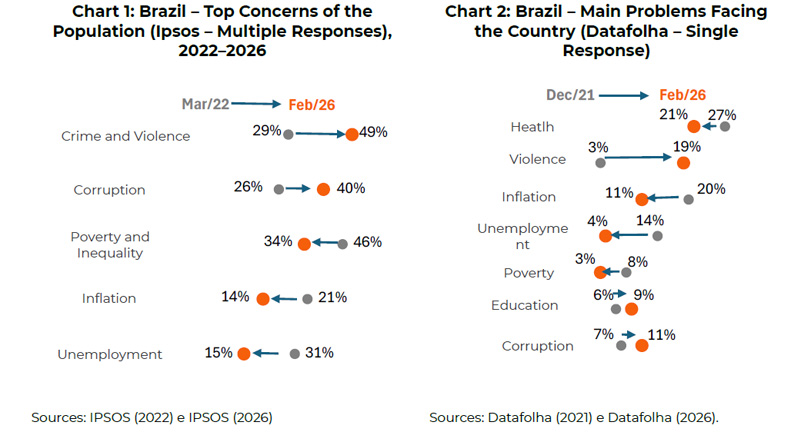
| We outline below the key issues likely to dominate the 2026 electoral cycle and assess how each may shape electoral outcomes. Charts 1 and 2 already provide a clear signal: crime and corruption have increased in salience over the past four years. Healthcare remains relevant, but less so than during the COVID-19 period, when it likely contributed to the defeat of the incumbent. Democracy, while not explicitly captured in Ipsos and Datafolha surveys, was a decisive issue in 2022 but is unlikely to carry the same weight in 2026. The economy does not appear to be a particularly sensitive topic at present, as inflation and unemployment are at relatively comfortable levels. ESG and diversity-related issues also show limited traction among voters. |
- Brazil will hold general elections in October 2026, including the presidency, governorships across all 27 federative units, the full renewal of federal and state legislatures, and two-thirds of the Senate.
- The ability to design effective campaign strategies, and to assign a well-grounded probability distribution to electoral outcomes, with direct implications for the macroeconomic outlook, depends critically on a proper understanding of Brazil’s socioeconomic context and voter positioning (i.e., key fears and aspirations).
- The first report addressed polarization and pessimism. This note focuses on the issues that most concern Brazilian voters. The third report will explore underlying values.
Agenda Setting
“Agenda setting” is a foundational concept in communication theory and has become central to modern political marketing. Those who shape the public debate tend to influence how voters perceive politics. The core idea is that the media may not be successful in telling people what to think, but it is highly effective in telling them what to think about. In practice, by selecting which issues receive prominence (e.g., corruption, public security), communicators structure the electorate’s mental agenda and influence political preferences.
Consistent with Charts 1 and 2 in previous page, crime and corruption have gained relevance over the past four years. Democracy, while decisive in 2022, is likely to be less central in 2026. The economy also appears less pressing than in previous cycles, and ESG/diversity topics remain of limited electoral importance.
Public Security
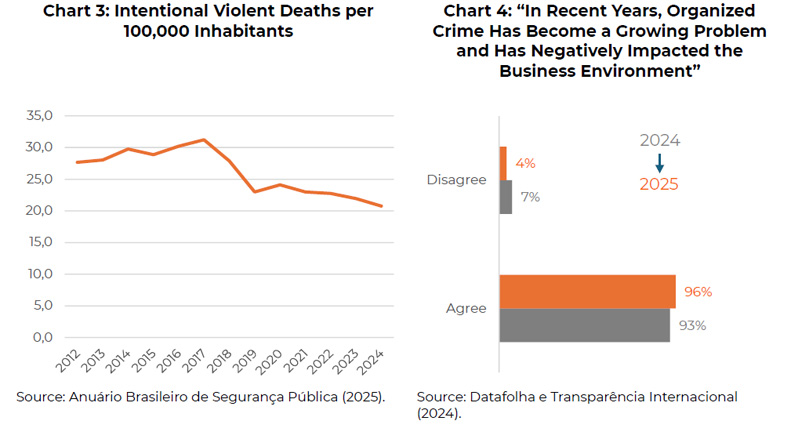
Public security, particularly violence, is likely to be the single most relevant issue in the 2026 elections. A key feature is the divergence between assessment and data. Despite a sharp increase in perceived insecurity, official statistics do not indicate a clear deterioration in crime indicators. Data from the Brazilian Public Security Yearbook and the Violence Atlas show no unequivocal worsening in homicides, theft, or robbery in recent years. For example, Chart 3 points to a declining trend in intentional violent deaths per 100,000 inhabitants since 2017.
Two factors may be playing a key role in driving the rise in concerns about violence: the surge in mobile phone theft and increased media coverage of criminal organizations such as the PCC (Primeiro Comando da Capital) and CV (Comando Vermelho).
A relatively new element in the public debate is the growing concern about the impact of crime on the business environment, including corporate operations (Chart 4). There is a widespread perception that organized crime is becoming increasingly present across multiple areas of society. Candidates who demonstrate greater willingness and capacity to address public security challenges are likely to hold a significant electoral advantage.
Corruption
Corruption is another issue that has gained prominence. There appears to be some overlap in public perception between corruption and public security, as illicit activities involving criminal organizations are often associated with violence and bribery. In the context of polarization and pervasive pessimism, voters are more inclined to assign responsibility broadly and to distrust institutions.
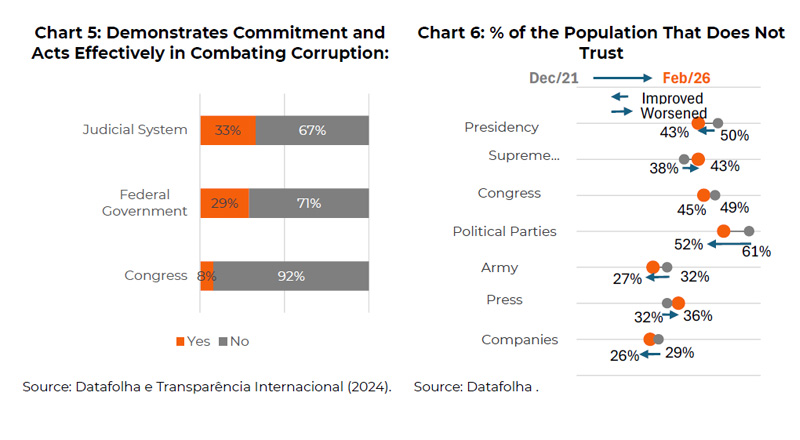
Survey evidence among compliance professionals suggests that both the judiciary and the executive branch are not perceived as sufficiently committed to combating corruption (Chart 5). At the same time, overall trust in institutions remains low but broadly stable relative to 2021–2022 levels (Chart 6).
Democracy
Democracy was likely the pivotal issue that shaped the outcome of the 2022 elections. Looking ahead to 2026, however, this topic does not appear likely to rank among the most relevant. Recent trials and penalties imposed on individuals associated with anti-democratic actions may have helped contain fears related to the loss of political freedoms.
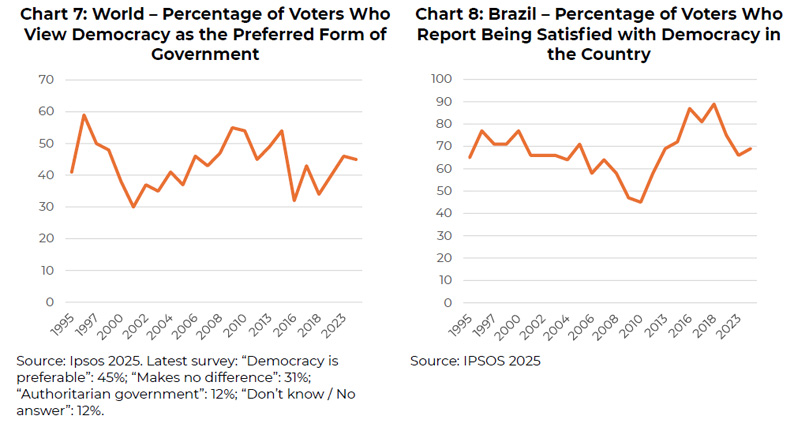
This is one possible interpretation of the charts on the following page, which track changes in voter perceptions of democracy over the past 30 years. On the right-hand side, the share of respondents who view democracy as the preferred system of government appears broadly in line with historical averages, neither as elevated as during the optimism surrounding the Real Plan in the mid-1990s or the strong economic expansion of the late 2000s, nor as depressed as during periods of declining confidence, such as the political transition in 2002 or the impeachment of President Dilma Rousseff (Chart 7). A similar pattern can be observed with respect to satisfaction with democracy in Brazil, which appears to have returned to a state of relative normalization (Chart 8).
Economy
It also appears difficult to argue that the economy will play a decisive role in the 2026 elections. Although issues such as inflation, growth, and inequality are consistently among individuals’ top concerns, voter attention does not seem to be currently focused on these factors.
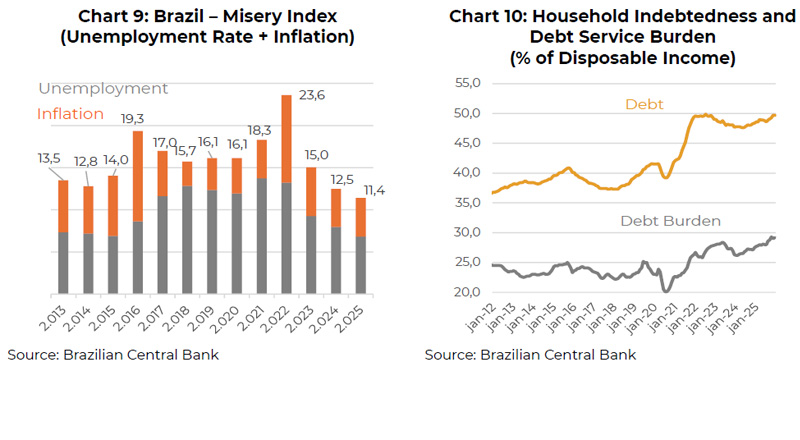
Households may, in fact, be reasonably satisfied with their current economic conditions. For instance, the so-called “misery index”, defined as the sum of unemployment and inflation, remains at relatively favorable levels (Chart 9). However, there may be growing skepticism regarding the underlying growth model, particularly as a significant portion of consumption has been supported by rising household indebtedness (Chart 10). In this context, voters may be less focused on improving current economic conditions and more concerned about preserving recent gains in terms of inflation and employment.
In this context, the economy does not appear to be a top priority for voters, nor is there a strong inclination to support a candidate based on their ability to address current financial conditions. Instead, voter behavior may be driven by the fear of losing recent gains in terms of lower inflation and unemployment.
The reasons behind the declining salience of economic concerns remain largely speculative. As discussed, rising indebtedness may be one factor, reflecting concerns about the sustainability of a growth model supported by fiscal expansion and credit, with inflation contained at the cost of relatively high interest rates.
Another explanation relates to a hierarchy of preferences: as fears of rising prices and job loss diminish, individuals tend to shift their focus toward other issues that rank higher in their hierarchy of concerns and aspirations.
References
Anuário Brasileiro da Segurança Pública. 2025. https://forumseguranca.org.br/publicacoes/anuario-brasileiro-de-seguranca-publica/
Atlas da Violência. 2025. https://www.ipea.gov.br/atlasviolencia/publicacoes/290/atlas-da-violencia-2025.
Corrupção e Integridade no Mercado Brasileiro. A Percepção dos Profissionais de Compliance. Datafolha e Transparência Internacional. 2024.
Folha de São Paulo 19 dez 2021 pp. A6
Folha de São Paulo 10 mar 2026 pp. A9
IPSOS. Flair Brasil 2026. Eco dos Tempos: como a colisão entre passado e presente moldam o fragmentado futuro do Brasil. Agosto de 2025.
IPSOS (2022). What Worries the World – March 2022
IPSOS (2026). What Worries the World – February 2026 | Ipsos
Cohen, Bernard C. The Press and Foreign Policy. Princeton University Press. 1963.
McCombs, M. e Shaw, D. The Ageda Setting Function of Mass Media. Public Opinio Quartely, v.36, n.2, p.176-187. 1972
Milanovic, B. Global Inequality. A New Approach for the Age of Globalization. The Belkanp Press of Harvard University Press. CA. Massachusetts. 2016 Neri, M. C. Shifts in Brazilian Income Distribution and Wellbeing in the 21st Century. FGV Editora. Rio de Janeiro. 2024;