| Current political polarization and pessimism may be linked to the discontent of a significant portion of the population that sees itself as a loser in a game arbitrated by institutions more concerned with self-preservation than with defending fair and impartial rules. The hand of the state comes to be seen as determining the allocation of wealth in favor of specific groups — sometimes perceived as undeserving — without imposing a relevant burden on the most privileged segments of society. Hence the strength of themes such as meritocracy, religion, and entrepreneurship. Polarization and pessimism in an electoral context favor populist approaches such as: the search for culprits, the presentation of simple solutions, attacks on institutions, and emotional appeals focused on fear. |
- Brazil will hold elections in October 2026 for president, governors of the 27 federative units, all seats in the federal and state legislatures, and two-thirds of the seats in the Senate.
- Both the ability to plan a campaign and to assign any well-grounded probability to the expected outcome — with its consequent impact on the macroeconomic outlook — depend fundamentally on a reasonable understanding of Brazil’s socioeconomic context, as well as on how voters position themselves (their main fears and aspirations).
- In this article we address the issue of polarization and pessimism. The second article will discuss the concerns and demands of Brazilian voters. The third will examine their worldview.
Polarization
The most striking feature of the 2026 electoral environment is, obviously, polarization. Among everything that may be considered a cause of this phenomenon — which occurs not only in Brazil but also in other large democracies — we attribute greater importance to two main factors: 1) The unequal impact of income growth during the most intense phase of globalization. 2) Anxiety and fear in the face of the rapid pace of change occurring in Brazil and around the world.
Unequal Impact of Income Growth in the Early 21st Century
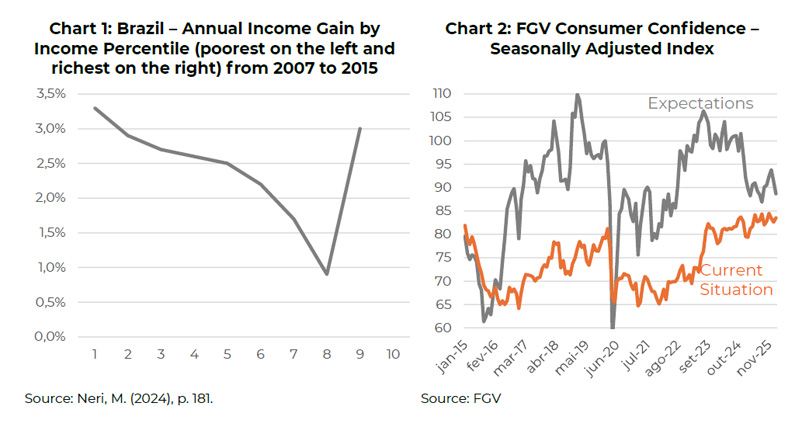
In the first case, we highlight evidence suggesting that income has grown more rapidly among the poorest segments of the world’s population over the past 25–30 years. The researcher Branko Milanovic, in his book Global Inequality: A New Approach for the Age of Globalization, presented the famous Elephant Curve for the period from 1998 to 2008, reproduced below (Chart 1). A similar pattern likely occurred in other countries and during subsequent years. In Brazil’s case, we rely on the compilation of data produced by researcher Marcelo Neri (Chart 2) for the period between 2007 and 2015.
Both charts appear to show that the reduction in inequality may have occurred (and is probably still occurring) at the expense of the so-called upper middle class. This does not represent an actual loss of income for this group, but some individuals may not feel satisfied when they see their standard of living improving more slowly than that of the rest of the population.
A sense of indignation would be natural, especially insofar as this dynamic is perceived as the consequence of public policies that benefit minorities or groups seen as less productive and less disciplined in relation to work and personal finances. The state may be viewed as a distributor of benefits that is unable to impose costs on the wealthiest (privileged) segments, whose income growth tends to remain robust. Hence the appeal of themes such as meritocracy, religion, and entrepreneurship.
Polarization runs counter to the median voter theory, which predicts that in majority voting systems voter preferences tend to gravitate toward candidates occupying more central positions in the spectrum of opinions. In a system that includes a second round, however, a political world divided by radicalism tends to bring radical candidates to the final stage. Moderation is not perceived as a virtue by the extremist masses.
Pessimism
The issue of anxiety and apprehension regarding the accelerated pace of change can be illustrated by data from the IPSOS FLAIR 2026 survey, which shows 91% of respondents agreeing with the statement “the world is changing too fast,” and 60% expressing nostalgia (they would like the country to “return to what it used to be”). Population aging is probably a key factor behind this sentiment.
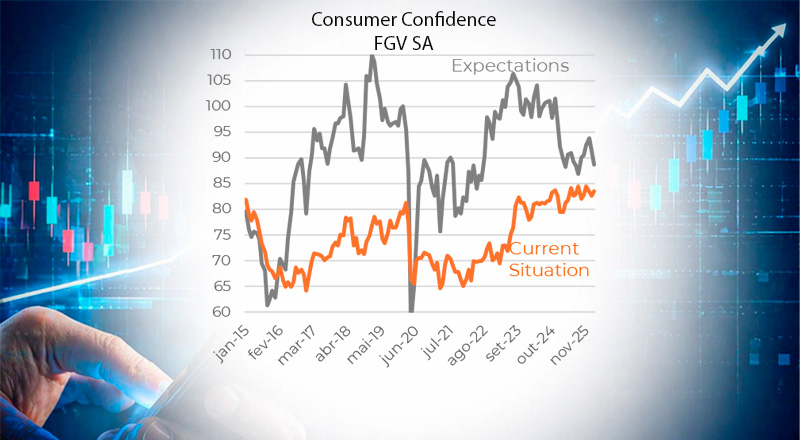
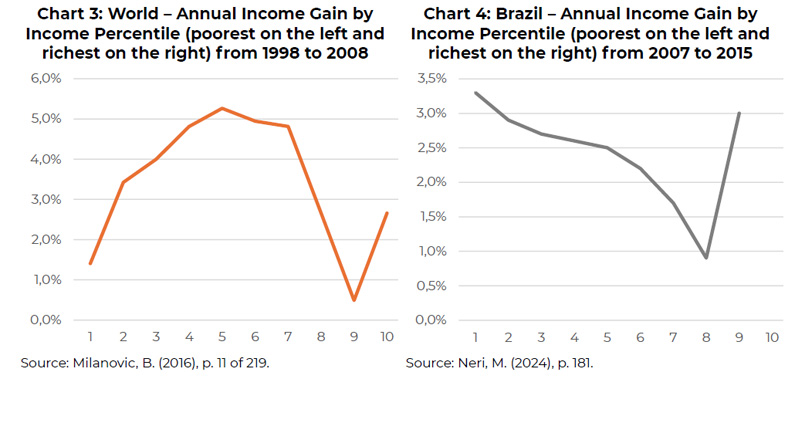
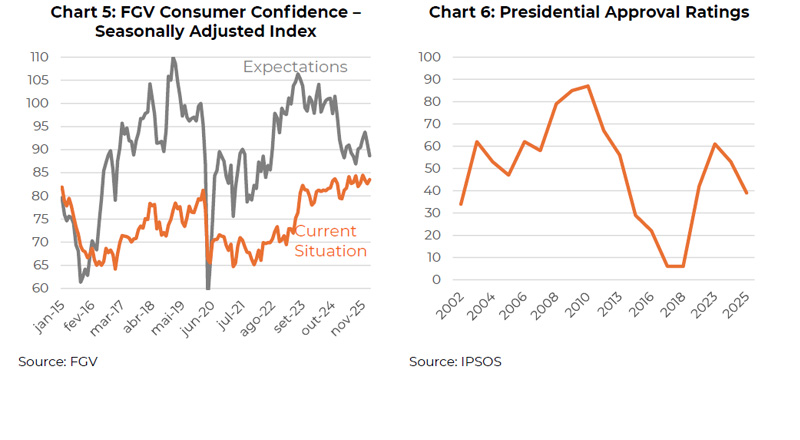
Fear is closely related to pessimism. Consider the case of the economy. Even when people perceive their current financial situation as satisfactory, they tend to express skepticism about the future. Chart 5 shows the FGV Consumer Confidence Survey. While the indicator related to current conditions is at its best level in the last ten years, perceptions related to expectations are as poor as during the worst moments of the same period. This result is consistent with the IPSOS survey showing 66% of respondents believing that Brazil “is on the wrong track.” In the survey conducted in mid-2025 — the peak of President Lula’s popularity (considering only the current term) — 22% of his own voters stated that the government was “worse than expected.”
In this context, a news environment filled with negative stories — especially those related to corruption scandals and patronage — only reduces the visibility of any light at the end of the tunnel. The skeptical voter perceives himself as a loser in a zero-sum game arbitrated by institutions that, in his view, act in a biased manner. Such individuals tend to demand change.
We know that electoral campaigns can alter perceptions. Communication strategies will attempt to manipulate salience — emphasizing the positive traits and minimizing the negative ones of each candidate. Campaigns may even succeed in changing how presidential contenders are perceived regarding their ability to generate the desired transformations. However, it will be extremely difficult for political marketing to change some of the most deeply rooted emotions among Brazilian voters in 2026: pessimism and fear.
Conclusion
Current political polarization and pessimism may be linked to the discontent of a significant portion of the population that sees itself as a loser in a game arbitrated by institutions more concerned with self-preservation than with defending fair and impartial rules.
The hand of the state comes to be seen as determining the allocation of wealth in favor of specific groups — sometimes perceived as undeserving — without imposing a meaningful burden on the most privileged segments of society. Hence the strength of themes such as meritocracy, religion, and entrepreneurship.
Polarization and pessimism in an electoral context favor populist approaches, such as: the search for culprits, the presentation of simple solutions, attacks on institutions, and emotional appeals focused on fear.
References
IPSOS. Flair Brasil 2026. Echoes of the Times: How the Collision Between Past and Present Shapes Brazil’s Fragmented Future. August 2025.
Milanovic, B. Global Inequality: A New Approach for the Age of Globalization. The Belknap Press of Harvard University Press. Massachusetts. 2016.
Neri, M. C. Shifts in Brazilian Income Distribution and Wellbeing in the 21st Century. FGV Editora. Rio de Janeiro. 2024.