
Job Creation Was Quite Weak in February, but the Overall Picture Is Not One of Fragility
- The latest data on the U.S. labor market raised concerns about the state of the economy, precisely at a time when additional monetary policy stimulus appears more difficult given the conflict in the Middle East.
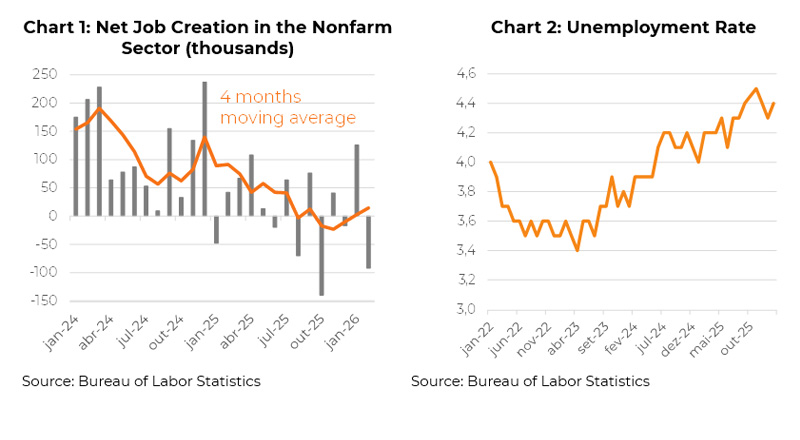
- It is premature to conclude that economic activity is weak or that unemployment is likely to rise. The loss of 92 thousand jobs in February in the nonfarm sector follows a gain of 126 thousand recorded in January. Additionally, part of the decline can be attributed to temporary factors, such as a strike in the healthcare sector. Finally, wage gains remain robust, demonstrating there is still strong bargaining power among workers.
- The destruction of 92 thousand jobs was particularly disappointing because expectations pointed to a net increase of 59 thousand jobs. The four-month moving average, however, remains in positive territory and has been rising since the lows reached in November of last year (Chart 1).
- The healthcare and social assistance sector, the main engine of employment growth for much of the past two years, recorded a decline of 18 thousand jobs. The strike at Kaiser Permanent alone explains about 31 thousand fewer positions last month.
- Unemployment rose from 4.3% in January to 4.4% in February, still below the three-year high recorded in November 2025.
- Average hourly earnings for all employees in the private nonfarm sector increased 0.4% in February, more than expected by the market consensus, reaching US$ 37.32. Over the past 12 months, the increase was 3.8%, virtually unchanged relative to previous readings.